Gurvan Saikhan National Park
Gurvan Saikhan National Park
Two million hectares of desert, mountains and canyons: Gurvan Saikhan park brings together the Khongoryn Els dunes, Yolyn Am canyon and the fossil-bearing cliffs of Bayanzag.
Govi Gurvan Saikhan National Park spans more than two million hectares across the Gobi Desert in southern Mongolia. It protects three mountain massifs — the "Three Beauties" — that rise from the desert plateau, sheltering canyons, dunes, fossil glaciers and remarkable wildlife. It is one of Central Asia's largest protected areas and the heart of any Gobi expedition.
Practical essentials at a glance
Entrance: park entrance fee (payable at the gate or through the local administration of Dalanzadgad).
Access: flight from Ulan Bator to Dalanzadgad, then 4×4 vehicle essential — no paved roads within the park.
Recommended duration: 3 to 5 days to cover the main sites.
Accommodation: ger camps inside and around the park's perimeter.
Best time: May-June and September-October; summer (July-August) is hot but feasible.
What to wear: warm clothes even in summer (cold nights at altitude), sunscreen essential.
What you'll see
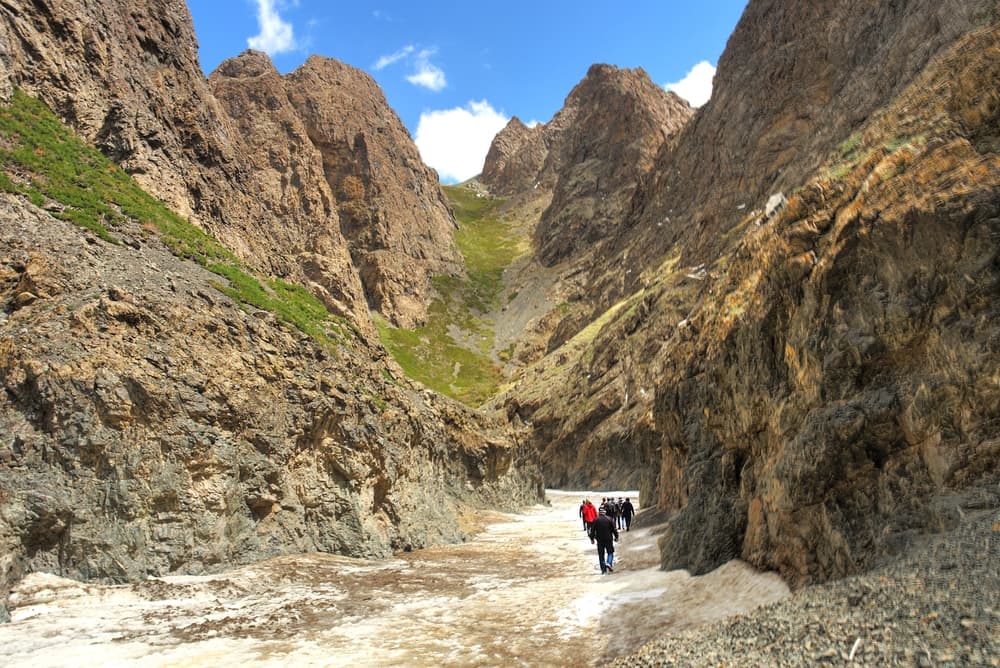
The park concentrates landscapes of rare diversity for a desert zone. The Khongoryn Els dunes, among the highest in Central Asia, dominate the western sector. Yolyn Am canyon, carved into the Zuun Saikhan massif, retains a ground glacier for much of the year. The cliffs of Bayanzag, tinged rust-red, have yielded some of the most significant dinosaur fossils of the 20th century.
History and context
The park was established in 1965, then significantly enlarged in the 1990s. The Bayanzag region has been known since American expeditions by the American Museum of Natural History in the 1920s, led by Roy Chapman Andrews, who discovered the first scientifically identified fossilized dinosaur eggs here. The Gobi remains one of the world's most active paleontological sites today.
Highlights of a visit
The Khongoryn Els dunes
These dunes reach up to 300 metres in height over a length of approximately 180 kilometres. The wind here produces a characteristic low rumble, earning them the nickname "singing dunes". Climbing to the ridge on foot offers panoramic views across the desert plains and surrounding mountains.
Yolyn Am canyon
This narrow canyon, carved into the Zuun Saikhan massif, shelters a watercourse that freezes in winter and forms a persistent ground glacier. The cool, humid environment contrasts sharply with the surrounding desert. Himalayan vultures and eagles nest here regularly.
The Bayanzag cliffs
Nicknamed "Flaming Cliffs" by Andrews, these red-orange sandstone formations stretch for several kilometres. Fossils of Protoceratops, Velociraptor and dinosaur eggs have been unearthed here. Evening light intensifies the colour of the cliffs.
Gobi wildlife
The park protects emblematic species: wild Bactrian camel (Camelus ferus), argali (Central Asian wild sheep), Mongolian gazelle, lynx and snow leopard at higher altitudes. Sightings remain unpredictable and depend on the season.
Photography tips
Khongoryn Els: golden light at dawn and sunset; long shadows reveal the dunes' relief.
Bayanzag: late afternoon for maximum saturation of rust-red hues.
Yolyn Am: diffuse light at midday within the enclosed canyon; bring a bright lens.
Protect equipment from fine sand omnipresent in dune areas.
No known photography restrictions in the park, except occasional local ranger directives.
Location and access
The park lies in Ömnögovi aimag (province), approximately 550 km south of Ulan Bator. The town of Dalanzadgad, served by regular flights from the capital, is the main logistical hub. Within the park, only a 4×4 vehicle with English-speaking driver-guide allows you to link the various sites, separated by dozens of kilometres across unmarked tracks. Local agencies organize circuits combining the three major sites.
Nearby attractions
Khongoryn Els dunes — the largest dunes of the Gobi, within the park itself.
Yolyn Am canyon — icy gorge sheltering remarkable cliff fauna.
Bayanzag cliffs — major paleontological site with distinctive red sandstone formations.
Dalanzadgad — provincial capital, logistical departure point with local museum on the Gobi.
Frequently asked questions
May-June and September-October offer moderate temperatures and favourable light. July-August is warmer but remains feasible. Winter (November-March) is extremely cold and access difficult.
An experienced guide and driver are essential. Tracks are unmarked, distances between sites are considerable and mobile coverage is virtually non-existent within the park.
Yes. Most organized circuits link Bayanzag, Yolyn Am and Khongoryn Els in 3 to 5 days, with nights in ger camps between stages.
The ground glacier typically persists until July or August depending on the year. In autumn and winter it is well formed. In late summer, it may be reduced or absent depending on that year's climatic conditions.
Yes, climbing on foot is permitted. It is physically demanding due to loose sand. Some camps also offer camel rides at the foot of the dunes.
The fastest option is a flight to Dalanzadgad (approximately 1h30). It is also possible to reach the region by 4×4 from the capital, a lengthy two-day journey across tracks.
Interested in this visit?
We can include it in your personalised itinerary.