Nemegt Uul
Nemegt Uul
In the remotest reaches of the Gobi, the Nemegt Mountains unveil ochre badlands and Upper Cretaceous geological formations worldwide renowned for their exceptional dinosaur fossils.
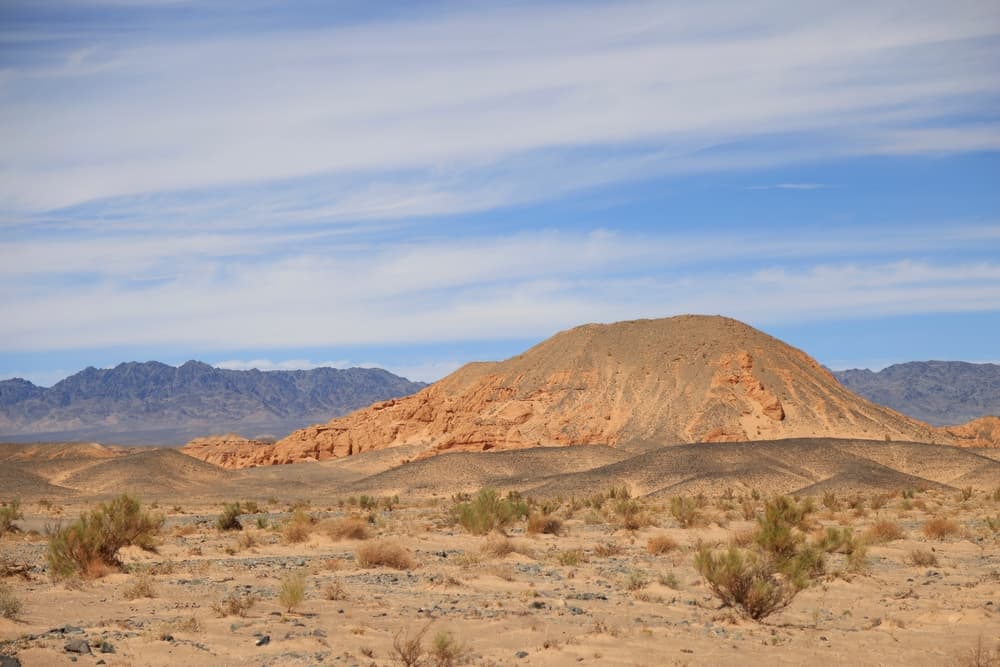
The Nemegt Mountains rise in the most remote corner of the Gobi Desert, in southern Mongolia. This arid massif is known throughout the paleontological world: its Upper Cretaceous sedimentary formations have yielded some of the best-preserved dinosaur skeletons ever discovered. For the traveler, it's a landscape of ochre and red badlands, almost lunar in aspect, far removed from any infrastructure.
What to See
The landscape is dominated by eroded hills in rust, beige, and gray tones, sculpted by millions of years of sedimentation and erosion. Geological layers lay bare, revealing strata of sandstone and clay dating to the Cretaceous. No dense vegetation: only scattered tufts of dry grass and isolated saxaul trees dot the horizon.
Badlands formations: ravines, hoodoos, and colorful cliffs characteristic of the deep Gobi.
Fossil-bearing sites: the zone has produced remains of Tarbosaurus, Saurolophus, and Therizinosaurus, among other iconic genera.
Silence and isolation: several hours' drive from the nearest town, the place offers complete solitude.
History and Context
Soviet-Mongolian scientific expeditions from the 1940s–1960s uncovered exceptional fossil deposits in the Nemegt Formation, the geological layer that lends its name to the massif. These discoveries reshaped understanding of Cretaceous fauna across Central Asia. International teams continue to conduct excavations here, subject to strict authorization from Mongolian authorities.
The name Nemegt refers to both the mountain massif and the geological formation, which sometimes creates confusion in scientific and travel literature.
Highlights of Your Visit
Badlands at sunrise and sunset
Raking morning and evening light transforms the cliffs into a symphony of orange and burgundy. This is the most spectacular time to observe the reliefs and photograph the geological strata.
The vast expanse of deep Gobi
From the ridges of the massif, views stretch for dozens of kilometers across barren desert with no sign of human presence. The experience of absolute isolation is particularly striking here.
The paleontological context
Even without visible excavations, knowing that the soil beneath your feet has preserved dinosaurs for 70 million years adds a singular dimension to your visit. A specialized local guide can contextualize the strata and historical discovery sites.
Photography Tips
Golden hour: prioritize the first two hours after sunrise or the hour before sunset—rock colors are most saturated then.
Stratification lines: frame horizontally to highlight the layered geological sequences.
Human silhouette: include a person in the frame to give scale and reinforce the sense of immensity.
Restrictions: collect no fossils or rock fragments—it's illegal and subject to severe penalties in Mongolia.
Practical Information at a Glance
Access: only by 4×4 vehicle with an experienced driver; tracks are unmarked and navigation requires local knowledge.
Recommended season: May–June and September–October—summers are scorching, winters brutally cold, and tracks sometimes impassable.
Recommended duration: plan for at least one night on-site (ger camp or bivouac) to enjoy morning and evening light.
Important rules: it is strictly forbidden to collect fossils or rocks. Respect active excavation zones if marked.
Accessibility: the terrain is entirely undeveloped, inaccessible to people with reduced mobility.
Location and Access
The Nemegt Mountains lie in Ömnögovi Province, in the deep Gobi. The most common logistical starting point is Dalanzadgad, the provincial capital, reachable by air from Ulan Bator. From there, the track to Nemegt crosses several hundred kilometers of desert and requires a 4×4 vehicle, adequate fuel supplies, and a local guide. No paved road reaches the massif.
Nearby Sites
Khermen Tsav — canyon with spectacular red cliffs, another major fossil site in the deep Gobi.
Bayanzag (Flaming Cliffs) — iconic paleontological site where Roy Chapman Andrews discovered the first dinosaur eggs in 1922.
Dalanzadgad — waypoint town with a local museum and basic services before venturing into the Gobi.
Frequently asked questions
Not practically. Unmarked tracks, extreme remoteness, and desert-related risks make an experienced local guide and reliable 4×4 vehicle with fuel reserves indispensable.
May–June and September–October offer tolerable temperatures. Summer (July–August) is very hot and storms can render tracks impassable. Winter is brutally harsh.
Fragments may surface, but it is strictly forbidden to touch or remove them. Major specimens discovered are preserved at the Natural History Museum in Ulan Bator.
No permanent lodging exists on-site. Travelers camp in tents or mobile gers set up by their team. Dalanzadgad has a few guesthouses and tourist ger camps.
Yes, a deep Gobi circuit often includes Bayanzag, Khermen Tsav, and Nemegt on a multi-day loop from Dalanzadgad. Logistics should be planned in advance with a local operator.
Interested in this visit?
We can include it in your personalised itinerary.