Petroglyphs of Khavtsgaït
Petroglyphs of Khavtsgaït
Carved into granite walls south of Ulaanbaatar, the Khavtsgait petroglyphs gather hundreds of rock art representations dating from the Bronze and Iron Ages.
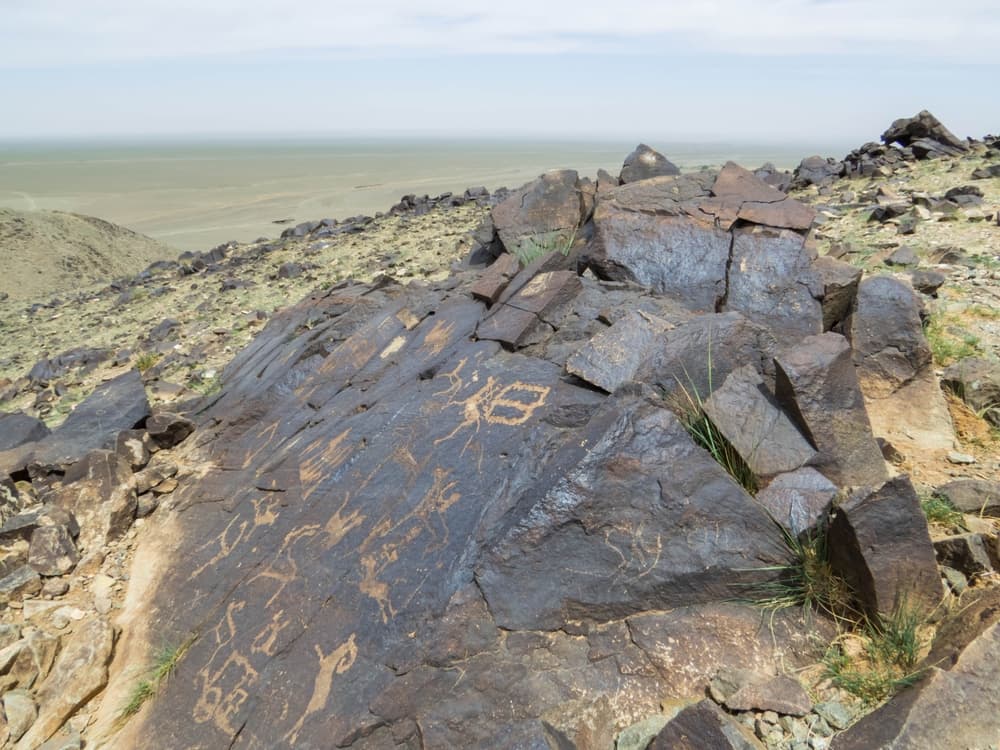
The Khavtsgait petroglyphs are located in the rocky hills south of Ulaanbaatar, not far from the Bogd Khan Uul massif. Carved into granite walls, these rock art representations date mainly from the Bronze Age and Iron Age. Animals, hunters, deer, and hunting scenes sit alongside more abstract symbols. The site offers direct contact with the earliest nomadic populations of Central Asia, without barriers or tourist staging.
Practical Info at a Glance
Access: open-air site, accessible on foot from the road; no formal welcome facilities on site.
Attire: hiking boots essential, rocky and sometimes steep terrain.
Recommended Duration: allow 1.5 to 2 hours to explore the main carved panels.
Guidance: a local guide is strongly recommended to locate the scattered carvings.
What You'll See
The rocks bear hundreds of carvings: deer with stylized antlers (the so-called "deer stone" motif), ibex, horses, mounted archers, and schematic human figures. Some panels overlap multiple periods, revealing continuous use of the site over millennia. The dark patina of the granite contrasts with the light-colored carved lines, making the figures readable to the naked eye.
History and Context
The earliest carvings date back to the Bronze Age (around 3,000–1,000 BCE), when steppe peoples depicted their prey and hunting rituals. Additions from the Iron Age and the Xiongnu period enriched the collection. Khavtsgait is part of a network of Mongolian rock art sites that extends to the Altai and the Gobi, testifying to a shared graphic tradition across Central Asia.
Highlights of Your Visit
Stylized Cervids
Representations of deer with disproportionately elongated antlers are characteristic of Bronze Age steppe art. Their schematic yet expressive style is identical to motifs found on deer stones scattered across Mongolia.
Hunting Scenes
Several panels show mounted archers encircling herds of ibex or aurochs. These narrative compositions are rare and give a precise idea of the collective hunting techniques practiced more than two thousand years ago.
Overlapping Eras
Observing the same rock carved centuries apart is one of the site's major interests. Styles change, the animals depicted evolve, but the support remains the same—a striking continuity.
Photography Tips
Raking light in the morning or late afternoon brings out the relief of the incisions. Avoid midday sun: carvings fade in flat light. A macro lens or zoom allows you to frame details without touching the walls. Never wet the rocks to "revive" the carvings: this accelerates their deterioration.
Location and Access
The site sits in the hills south of Ulaanbaatar, near the Bogd Khan Uul National Park. The access track requires a 4x4 vehicle or a high-clearance car. From central Ulaanbaatar, allow approximately 30 to 45 minutes of travel depending on the exact entry point. No public transportation serves the site directly; a rental car or guide-driver is necessary. Accessibility for visitors with reduced mobility is limited due to the natural, unimproved terrain.
Nearby
Bogd Khan Uul National Park — protected forest and hiking above Ulaanbaatar, a few kilometers north of the site.
Manzushir Monastery — ruins of a great 18th-century Buddhist monastery in the foothills of Bogd Khan.
Zaisan Memorial — Soviet monument on a hill south of Ulaanbaatar, with panoramic views over the capital.
Frequently asked questions
May to September, when the tracks are passable and the weather is mild. In winter, snow may cover the carvings and the tracks become difficult to access.
A local guide is strongly recommended. The carvings are scattered over several rocks and difficult to locate without prior knowledge of the terrain.
Yes, both sites are located in the same area south of Ulaanbaatar. A full day allows you to visit both without rushing.
The site benefits from protection under Mongolia's cultural heritage designations, but it is not fenced. It is essential not to touch or trace the carvings.
Hiking boots with cleated soles are essential. The terrain is rocky, sometimes slippery, with moderate elevation changes.
Interested in this visit?
We can include it in your personalised itinerary.