Taikhar chuulu
Taikhar chuulu
Taikhar Chuluu is a massive granite rock that rises from the plains of the Khoid Tamir Valley in Arkhangaï Province, central Mongolia.
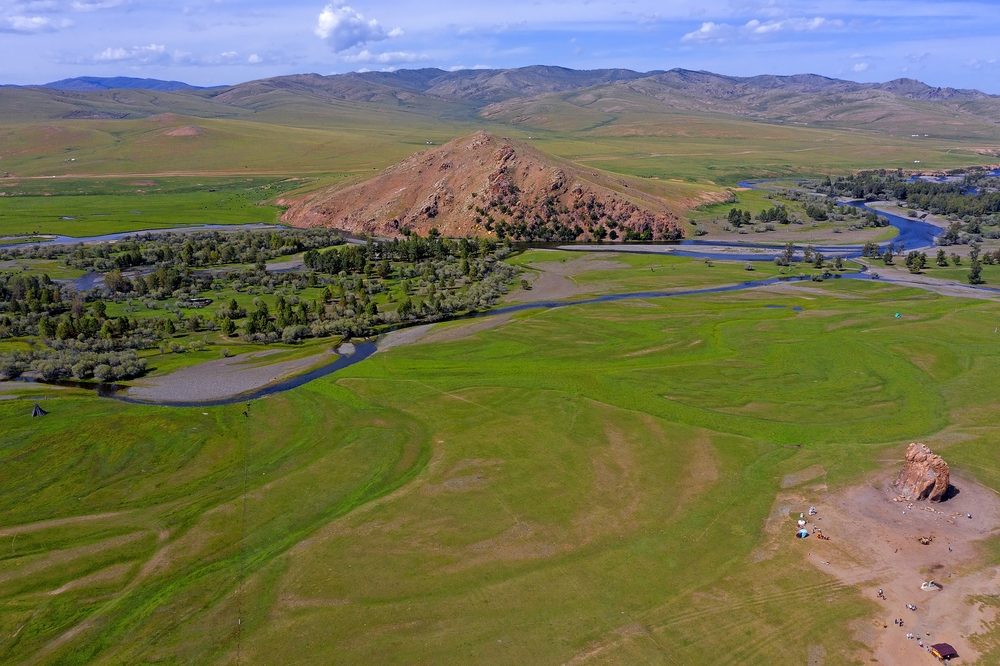
Taikhar Chuluu is a massive granite rock that rises from the plains of the Khoid Tamir Valley in Arkhangaï Province, central Mongolia. Standing roughly 20 meters high, its surface is covered with inscriptions carved over several centuries — ancient Turkish runes, Tibetan characters, classical Mongolian script. For the region's inhabitants, it is a sacred site linked to an ancient local legend. Its isolated silhouette in the steppe landscape makes it an immediately recognizable visual landmark.
Quick Facts at a Glance
Access: along the road connecting Tsetserleg to Tsenkher, in immediate proximity to the Khoid Tamir River.
Admission: open-air site, freely accessible.
Recommended duration: 30 to 60 minutes to walk around and read the inscriptions.
Dress code: no specific requirements, but respect the sacred nature of the place.
What You'll See
The rock itself is the centerpiece — a mass of gray-pink granite, nearly vertical, contrasting sharply with the surrounding herbaceous plain. Its surface is covered with hundreds of inscriptions carved at different periods — some dating back to the era of the ancient Turks (6th–8th centuries), others to the Buddhist or medieval Mongolian period. Ritual offerings (blue khadags, stacked stones) testify to the site's continuing veneration.
History and Context
The first identified inscriptions on Taikhar Chuluu date to the period of the Turkish Khaganates. The rock subsequently served as an epigraphic support throughout the Mongolian Middle Ages and into the Buddhist era. Local legend tells of a hero named Bukhbilegt who wielded this rock as a weapon against a giant serpent threatening the valley — a tale that partly explains the site's sacred significance in Arkhangaï's collective memory.
Highlights of Your Visit
The Rock Inscriptions
Make a complete circuit of the rock to identify the different layers of writing. The ancient Turkish runes, rarer, stand apart from the Tibetan Buddhist characters carved later. Some inscriptions remain legible; others have been altered by erosion or modern graffiti.
The Valley Panorama
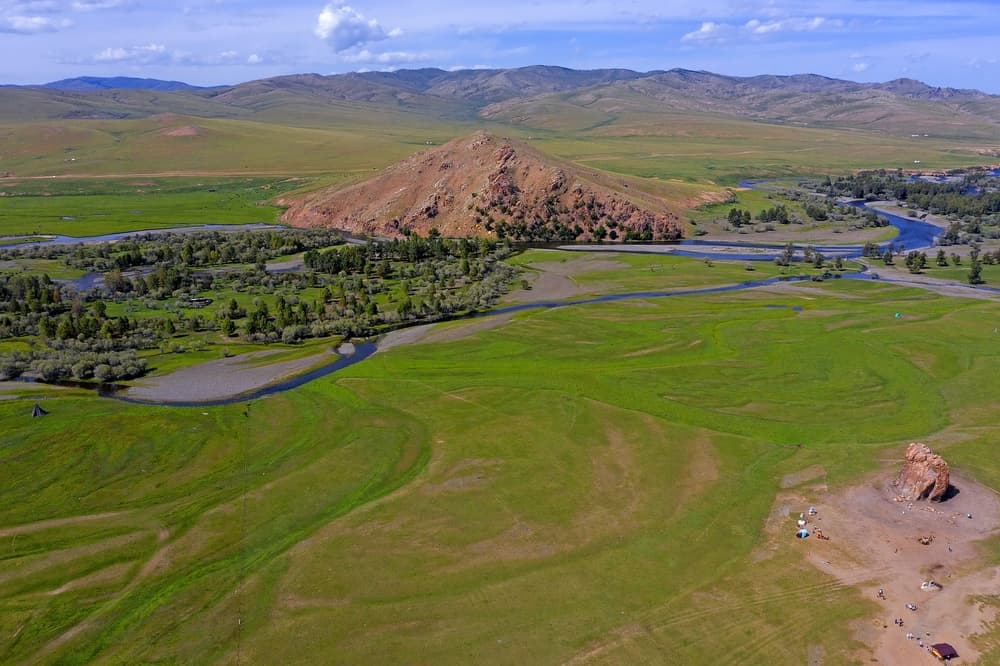
From the base of the rock, you have an open view over the Khoid Tamir River and the verdant hills of Arkhangaï. In summer, the steppe is an intense green; in autumn, golden tones frame the gray granite.
The Ritual Atmosphere
Ovoos (ritual cairns) and khadags adorn the base of the rock. Local families stop regularly to leave offerings. Observing this living relationship with the sacred is as instructive as the inscriptions themselves.
Etiquette and Visiting Rules
Do not touch the offerings left at the base of the rock.
Avoid climbing on the rock: beyond the danger, it is considered disrespectful.
Do not carve anything on the surface — modern graffiti has already damaged historical inscriptions.
Circumnavigate the site clockwise, following Mongolian Buddhist tradition.
Photography Tips
Morning light (before 10 a.m.) illuminates the east face of the rock and brings out the relief of the inscriptions. In late afternoon, raking light from the west better reveals shallow carvings. Step back about 100 feet to frame the entire rock with the river in the background.
Location and Access
Taikhar Chuluu lies in the Khoid Tamir Valley, approximately 12 miles west of Tsetserleg, the provincial capital of Arkhangaï. The road is passable in a standard vehicle in summer. The site is visible from the main road; a small informal parking area exists nearby. No regular public transport serves the rock directly — a rental vehicle or local driver is necessary.
In the Vicinity
Tsenkher Hot Springs — natural thermal baths, about 20 kilometers to the southwest.
Tsetserleg — provincial town with a regional museum housed in a former monastery, a logical base for your visit.
Zayain Khüree Monastery (Tsetserleg) — a partially preserved Buddhist complex in Tsetserleg itself.
Frequently Asked Questions
Frequently asked questions
From June to September, the road is passable and the valley is lush. In July–August, the days are long, allowing time to combine a visit with the Tsenkher springs. Avoid the thaw period (April–May) when tracks can be muddy.
It is not recommended: the rock is considered sacred by local inhabitants, and the stone can be slippery. Stay at the base to observe the inscriptions.
Allow 30 to 60 minutes to complete a full circuit of the rock and examine the inscriptions. If you wish to photograph in detail or wait for optimal light, plan a bit longer.
From Tsetserleg, one day is enough to visit Taikhar Chuluu in the morning and the Tsenkher hot springs in the afternoon. The Tsetserleg museum can be visited the day before or after.
There are no detailed interpretive panels on site. A local guide or a specialized guidebook on Arkhangaï allows you to better understand the different inscription periods.
Interested in this visit?
We can include it in your personalised itinerary.