Öliin Dawaa
Öliin Dawaa
Öliin Dawaa Pass, in the highlands near Terelj National Park, opens onto panoramic vistas of Mongolian steppes and forests.
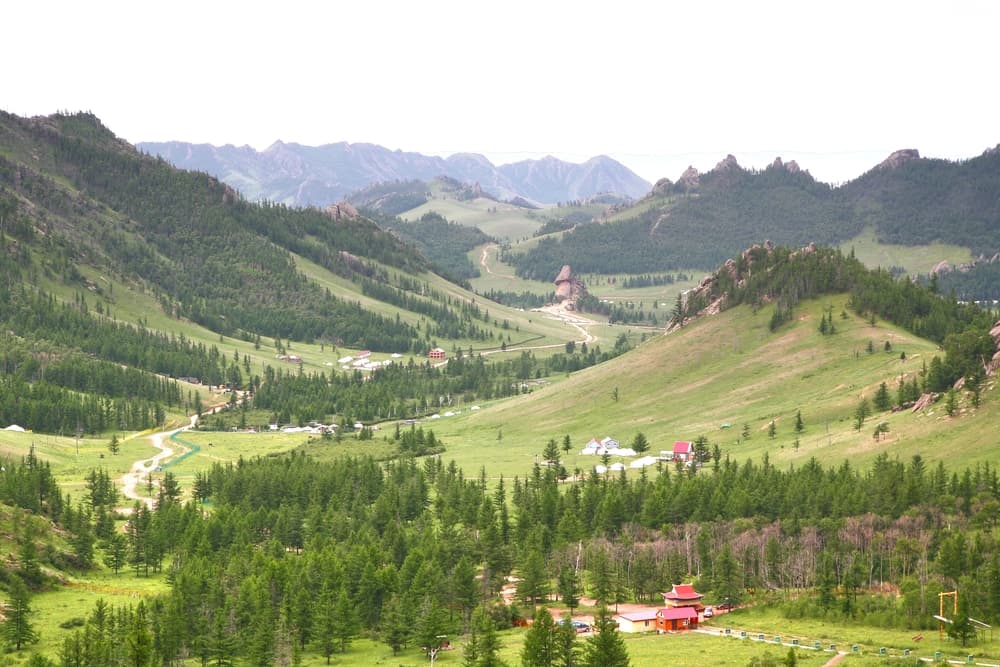
Öliin Dawaa Pass rises in the foothills that border the Terelj valley, a few hours' drive from Ulaanbaatar. This high mountain passage offers sweeping panoramas of the steppes and larch forests that characterise central Mongolia. Trekkers and horsemen use it to traverse ridgelines between neighbouring valleys, far from marked tourist routes.
What to see
From the pass, your gaze sweeps across rounded hills covered with coniferous forests to the north and open grasslands to the south. Ovoo — shamanic ritual cairns adorned with blue ribbons — mark the summit, as they do on most Mongolian passes. In summer, the slopes welcome herds of horses and yaks tended by nomadic families.
History and context
Mountain passes (dawaa in Mongolian) occupy a central place in the country's human and spiritual geography. For centuries, herding families have crossed them during seasonal migrations between summer and winter pastures. The ovoo at the summit is a place of prayer: travellers circle it three times clockwise and leave a stone or offering before continuing their journey.
Highlights of your visit
The panorama from the summit
On clear days, the view embraces several valleys and forested ridgelines stretching towards Gorkhi-Terelj National Park. The absence of any construction amplifies that profound sense of vastness characteristic of Mongolian landscapes.
The ovoo and shamanic practice
The pass's ovoo is a living point of contact with Mongolian animist beliefs. Honouring the ritual of circling and making an offering is appreciated by locals and lends concrete cultural depth to your stop.
Mountain flora and fauna
The pass's surroundings are home to marmots, common on grassy slopes, and various mountain bird species. In June and July, wildflowers carpet the high meadows.
Etiquette and visiting rules
Circle the ovoo clockwise, never counterclockwise.
Leave a stone, coin or symbolic offering before departing.
Do not touch the blue ribbons (khadag) attached to the ovoo.
Avoid speaking loudly or behaving disrespectfully near the cairn.
Photography tips
Early morning and late afternoon light is most favourable: it sculpts the terrain and gives depth to the valleys. The ovoo with billowing blue ribbons makes an effective foreground. Always ask permission from herders before photographing their livestock or gers.
Location and access
The pass sits within or immediately adjacent to Gorkhi-Terelj National Park, in Töv province. Access is by four-wheel-drive vehicle from Ulaanbaatar, then on foot or horseback from the valley floor. Tracks are unpaved; a local driver familiar with the terrain is essential. Wheelchair access is not possible due to the natural terrain.
Nearby attractions
Gorkhi-Terelj National Park — a vast protected area of forests and rivers, a base for trekking and horseback riding.
Turtle Rock (Melkhii Khad) — an iconic granite formation in the Terelj valley.
Aryabal Monastery — a Buddhist temple perched in the Terelj hills, accessible on foot.
Ulaanbaatar — Mongolia's capital and the logical departure point for any excursion in the region.
Frequently asked questions
From June to September, tracks are passable and vegetation is at its greenest. July brings the Naadam festival to the entire region. Avoid winter: passes are often snow-covered and temperatures are extreme.
A local driver or guide is highly recommended. Tracks are unmarked and conditions can change rapidly. Local agencies based in Ulaanbaatar or Terelj organise this type of excursion.
Yes, this is the natural combination. The pass fits seamlessly into a two to three-day circuit that includes Turtle Rock, Aryabal Monastery and an overnight stay at a ger camp.
Always circle clockwise, leave an offering (stone or coin) and do not touch the ritual ribbons. These gestures show respect for Mongolian shamanic tradition.
Bring sturdy walking shoes, layered warm clothing (wind can be fierce at altitude even in summer) and sun protection. Mountain weather in Mongolia changes rapidly.
Want to discover this destination?
Our local advisors design your tailor-made trip.