Orkhon Cascades
Orkhon Cascades
Deep in the Orkhon Valley, a UNESCO World Heritage site, Ulaan Tsutgalan Waterfall plunges into a volcanic canyon carved approximately 20,000 years ago.
Deep in the Orkhon Valley, a UNESCO World Heritage site, Ulaan Tsutgalan Waterfall plunges into a volcanic canyon carved approximately 20,000 years ago. The Orkhon River cascades down a basalt cliff some 65 feet high, surrounded by meadows and larch forests. This spectacular natural site is one of the rare places in Mongolia where volcanic landscape, river, and steppe converge into a single panorama.
Quick Facts
Access: unpaved track from Kharkhorin (approximately 60 km); 4×4 vehicle essential.
Best season: June to September — the waterfall reaches peak flow after July-August rains.
Recommended duration: half-day on-site, often combined with an overnight stay at a ger camp.
Accommodation: several tourist ger camps located in immediate proximity.
Winter: the waterfall partially freezes into spectacular ice sculptures, but access is challenging.
What You'll See
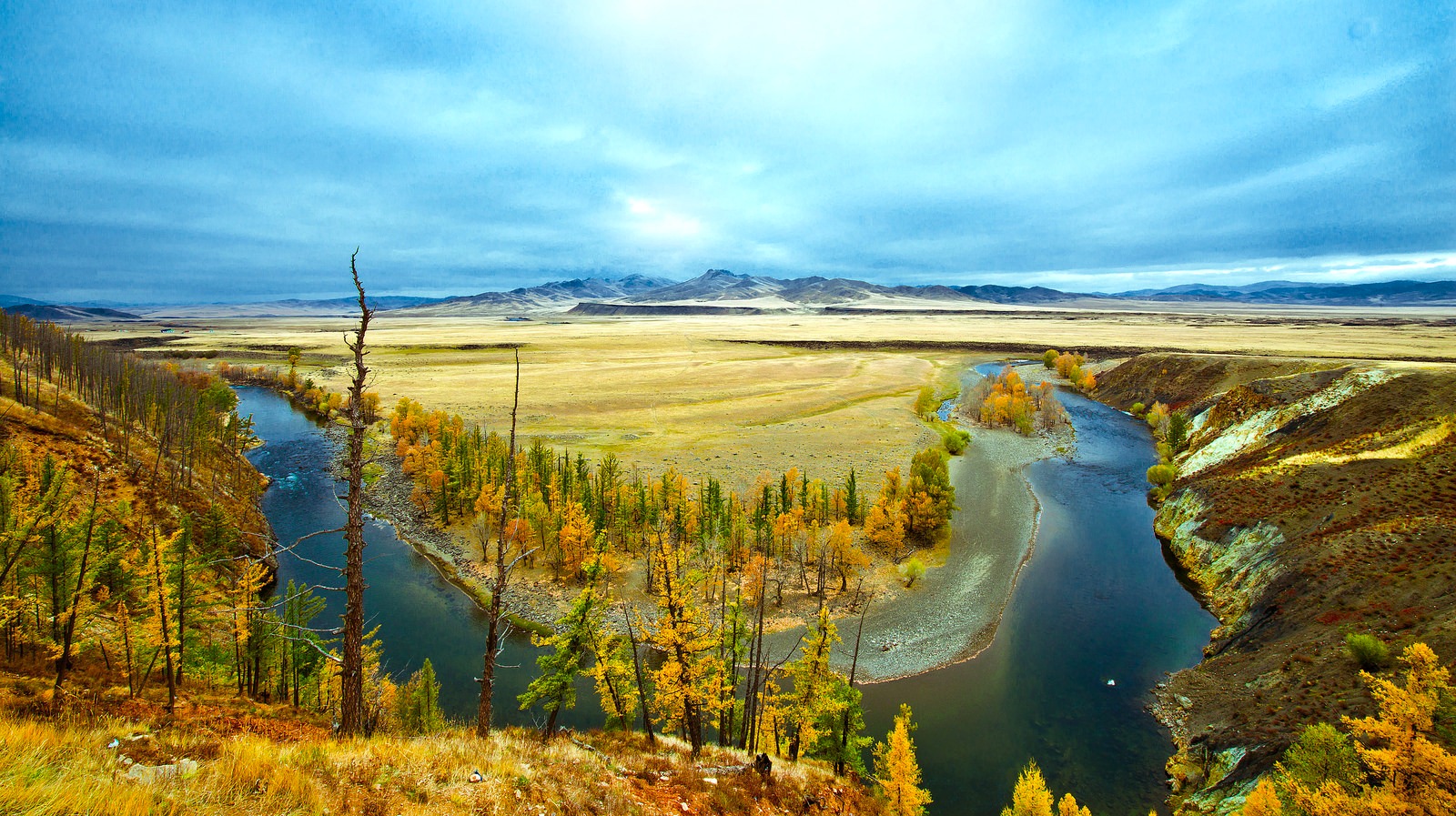
The main cascade plunges into a basin surrounded by black basalt columns, remnants of ancient volcanic activity. The canyon downstream offers sweeping views of the Orkhon River winding through the steppe. The immediate surroundings are scattered with wild flowers in summer and herds of wild horses grazing freely.
History and Context
The Orkhon Valley cradled several nomadic empires, including Genghis Khan's Mongol Empire. The volcanic canyon hosting the waterfall formed during prehistoric eruptions. The Orkhon River itself is Mongolia's longest and irrigated the great nomadic capitals of the region for centuries.
Visit Highlights
Canyon Edge
A trail runs along the canyon rim to a viewpoint overlooking the falls. Descent to the basin is possible but requires caution: the basalt ground is uneven and can be slippery after rain.
Downstream Valley
Following the river downstream, the landscape opens onto a vast steppe valley. Here nomadic families pitch their gers in summer, and herds of yaks and horses graze freely.
Winter Waterfall
Between December and February, the cascade partially freezes into a blue and white ice waterfall. Access is considerably more difficult, but the spectacle is breathtaking for well-equipped travelers.
Photography Tips
Morning light strikes the waterfall directly and avoids backlighting. In July-August, green vegetation contrasts sharply with black basalt — ideal for wide-angle shots. From the canyon rim, a wide lens captures both the waterfall and the valley beyond. Avoid midday hours in summer: the light is harsh and crowds tend to gather.
Location and Access
The waterfall lies in Övörkhangai Province, approximately 60 km west of Kharkhorin (Karakorum). The track is passable only by 4×4; no public transport serves the site. Most visitors arrive via organized tour from Ulaanbaatar, with a stop in Kharkhorin. Allow 6 to 7 hours' drive from the capital depending on track conditions.
Nearby Attractions
Kharkhorin (Karakorum) — ancient capital of the Mongol Empire, with nearby Erdene Zuu monastery.
Erdene Zuu Monastery — Mongolia's first Buddhist monastery, built atop the ruins of Karakorum.
Orkhon Valley — UNESCO site, steppe and river landscape dotted with nomadic heritage sites.
Frequently Asked Questions
Frequently asked questions
July and August offer the strongest flow thanks to summer rainfall. June and September are quieter and equally accessible. In winter, the waterfall partially freezes, but the track becomes very challenging.
Yes, a 4×4 is essential. The track from Kharkhorin is unpaved and can become muddy after rain. No public transport serves the site.
Several tourist ger camps are set up near the waterfall during summer season. An overnight stay lets you enjoy the site early in the morning, before tour groups arrive.
Yes, this is the classic pairing. Most tours include a visit to Erdene Zuu monastery in Kharkhorin before heading to the waterfall for the night.
The site is within a protected zone of the Orkhon Valley. Visitors are asked not to leave litter and to stay on marked trails near the canyon to prevent erosion.
Want to discover this destination?
Our local advisors design your tailor-made trip.