Potanine Glacier
Potanine Glacier
Potanine Glacier is Mongolia's largest glacier, hidden within the Tavan Bogd massif at the country's far western edge, where Kazakhstan and Russia converge.
Potanine Glacier is Mongolia's largest glacier, nestled in the Tavan Bogd massif at the country's far western edge, where Kazakhstan and Russia converge. It sprawls across the flanks of Mount Khuiten, Mongolia's highest peak at 4,374 m. This valley glacier draws mountaineers and trekkers seeking rare high-altitude scenery in Central Asia.
Quick Reference
Access: from Ölgii, the provincial capital, by 4x4 to Tavan Bogd base camp, then on foot or horseback.
Best season: June through September — passes and trails are open, recent snow is limited.
Recommended duration: allow a minimum of 2 to 3 days for the round trip from base camp.
Gear: mountain equipment essential — thermal layers, waterproof clothing, crampons if ascending the glacier.
Permits: the Tavan Bogd massif is a protected national park; an entry permit is required.
What You'll See
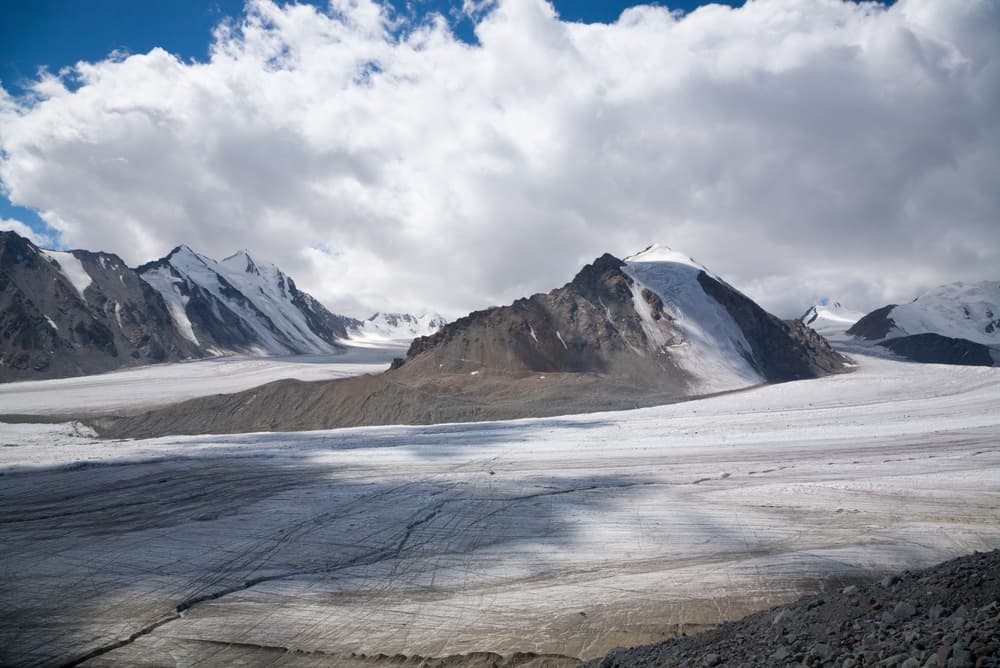
The glacier descends several kilometers from the snow-capped peaks of Tavan Bogd. Its glacier tongue, striped with dark lateral moraines, contrasts sharply with the white of upper névé fields. Below, turquoise proglacial lakes form as the ice melts seasonally. High-altitude wildlife—argali sheep and golden eagles—occasionally appear on the slopes.
History and Context
The glacier bears the name of Russian geographer and explorer Grigori Potanine, who traversed the Mongolian Altai in the late 19th century. His expeditions produced the region's first scientific descriptions. Today, the glacier's retreat is documented by Mongolian and international researchers as an indicator of climate change across Central Asia.
Highlights of Your Visit
The Glacier Tongue and Moraines
Walking the lateral moraine offers sweeping views across living ice. The striations and crevasses visible from the edge provide direct insight into glacial dynamics without requiring climbing gear.
Proglacial Lakes
Downstream from the glacier's front, shallow lakes with milky or turquoise waters form each summer. These serve as a major photo stop and a favored bivouac point for trekkers.
The Ascent to Mount Khuiten
For equipped mountaineers, the glacier provides the route to Khuiten (4,374 m). The climb demands high-altitude experience and ideally a certified local guide. The panorama from the summit spans three countries.
Photography Tips
Morning light before 9 a.m., raking across the ice, reveals seracs and moraine textures beautifully. Proglacial lakes mirror the peaks midday under clear skies. Avoid the frequent afternoon haze common late in the day. Protect your gear from humidity and cold nights.
Location and Access
The glacier lies within the Tavan Bogd National Park, Bayan-Ölgii Province, at Mongolia's far western reaches. The nearest city is Ölgii, reachable by air from Ulaanbaatar. From Ölgii, local agencies arrange 4x4 transfer to base camp (unpaved track, several hours' drive). Horses can be rented on-site to reach the glacier's foot. Wheelchair access is not feasible given the terrain.
Nearby Attractions
Mount Khuiten — Mongolia's highest peak, accessible from the same base camp for experienced mountaineers.
Khoton Lake — high-altitude lake with clear waters in Tavan Bogd park, a classic stop en route to the glacier.
Ölgii — capital of Mongolia's Kazakh province, the logistical hub with artisanal markets and vibrant Kazakh culture.
Eagle Festival — annual gathering of Kazakh eagle hunters, held in Ölgii each autumn.
Frequently Asked Questions
Frequently asked questions
June through September, trails are passable and weather most stable. July and August offer the longest daylight and mildest temperatures at base camp.
Yes, Tavan Bogd National Park is a protected zone requiring an entry permit. Local agencies based in Ölgii typically handle this for their clients.
No. The moraine and glacier front are accessible on foot for any reasonably fit trekker. Ascending Mount Khuiten via the glacier, however, requires high-altitude experience and specialized equipment.
Yes. Khoton Lake and Khurgan Lake are close by and naturally fit into a multi-day circuit from Ölgii. Some travelers add the Eagle Festival in October.
Thermal layers, waterproof jacket, hat and gloves even in summer, waterproof hiking boots with ankle support. If walking on ice, crampons and an ice axe are essential.
Want to discover this destination?
Our local advisors design your tailor-made trip.