Khambiin Khiid Monastery
Khambiin Khiid Monastery
Founded in the 17th century by Zanabazar, Erdene Khambiin Khiid monastery preserves at the foot of the Khögnö Khan massif the memory of the 1688 massacre.
At the foot of Khögnö Khan mountain, in Övörkhangaï province, the Erdene Khambiin Khiid monastery preserves the memory of a bloody episode in Mongolian Buddhist history. Founded in the 17th century by Zanabazar, the first religious leader of Mongolian Buddhism, it bore the imprint of his spiritual teacher, the monk Erdene, from whom it takes its name: "Monastery of the Monk Erdene."
Why visit Khambiin Khiid monastery
The site brings together three interests rarely found in the same location in central Mongolia. First, it is an architectural testimony to the 17th century, when Zanabazar was structuring the Mongolian monastic institution. Second, it is a memorial site linked to one of the major political and religious conflicts of Inner Asia, opposing western and eastern Mongolia over submission to the Manchus. Finally, it is a natural gateway to the Khögnö Khan massif, whose granite and steppe landscapes contrast with the semi-arid Elsen Tasarkhaï area nearby.
The monastery is no longer in regular operation, but monks return one or two times a month for ceremonies. This discretion preserves the contemplative atmosphere of the place, away from major tourist routes.
History: Zanabazar, Galdan Boshigt and the Khögnö massacre
The monastic complex was built in the 17th century by Zanabazar (1635-1723), the first Bogd Gegeen of Mongolia, in honor of his teacher, the monk Erdene. The site at its height housed more than a thousand lamas and counted among Zanabazar's preferred sanctuaries.
In 1688, the political context precipitated its ruin. King Galdan Boshigt, sovereign of the Oirats of western Mongolia, refused submission to the Qing Manchu dynasty. Zanabazar, conversely, defended the opposite position in central Mongolia. The disagreement degenerated into war. Galdan Boshigt marched on the neighboring Khögnö Tarinii Khiid monastery to capture Zanabazar there, but did not find him. Furious, he ordered that all the monks be put to their knees and beheaded on the spot.
In Mongolian, this act of execution is called "Khögnö." The word has since given its name to the mountain, valley, and several surrounding sites, preserving the toponymic trace of the tragedy. The monastery itself, sometimes called the Ovgon monastery, never regained its pre-1688 splendor.
What to see on site
- The ruins of the lower monastery: remains of walls and stone foundations, scattered at the foot of the relief.
- The upper temple: accessible by a trail that climbs into the massif, it offers an open view over the surrounding steppe.
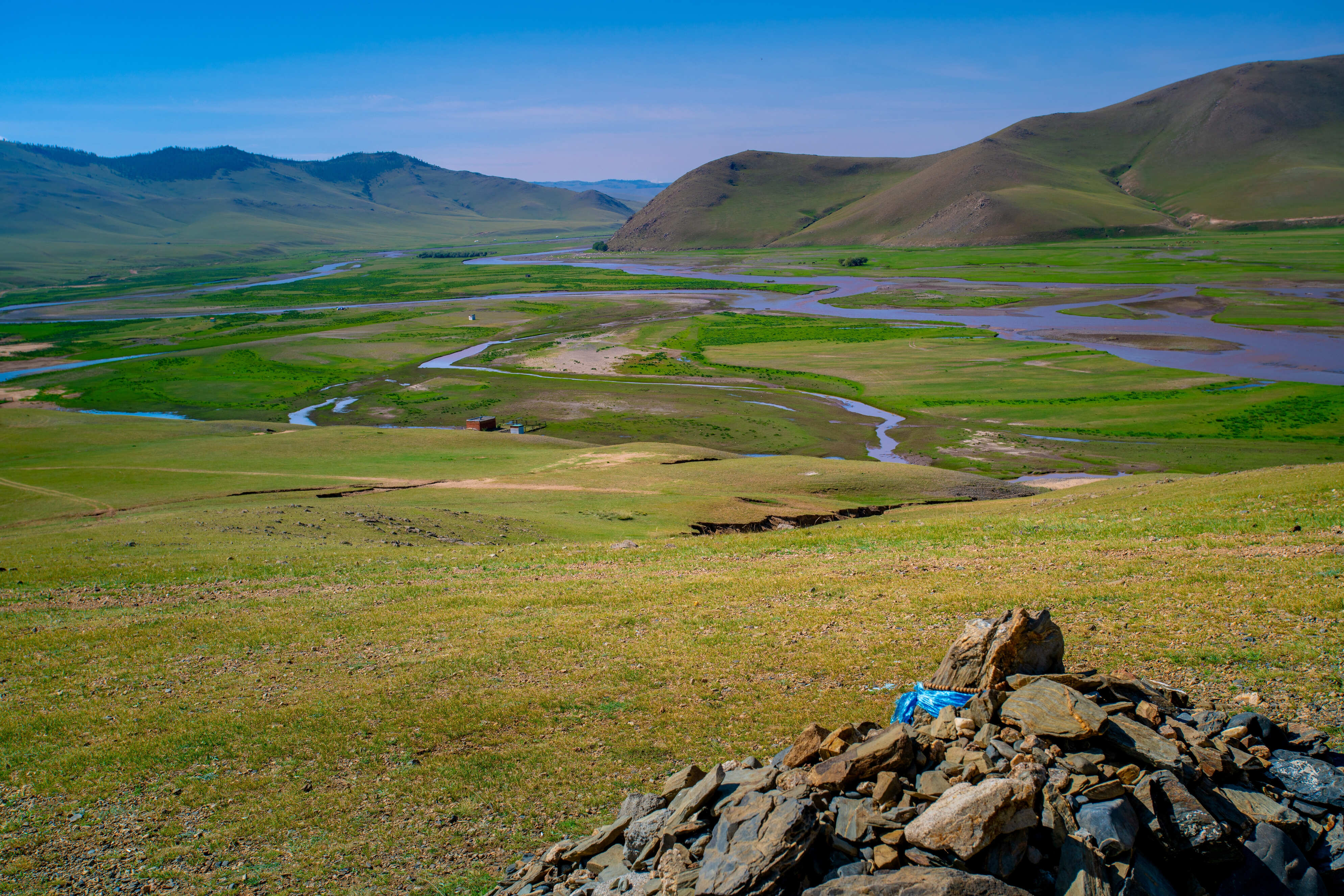
- The ovoos (ritual cairns) installed on the heights, still frequented by visitors and local herders.
- The Khögnö Khan landscape: granite chaos, grassy valleys and, to the south, the first dunes of Elsen Tasarkhaï, nicknamed the "Little Gobi."
Allow 1.5 to 2 hours for a visit if you climb to the upper temple, longer if you extend with a hike through the massif.
Practical information
- Access: free, the site is not enclosed. A symbolic contribution may be requested for maintenance.
- Visit duration: 1.5 to 3 hours depending on whether you include the hike to the upper temple.
- Equipment: hiking shoes, water, sun protection. The trail is dry and exposed.
- Behavior: walk around the ovoos clockwise, do not photograph the interior of temples without permission during ceremonies.
When to go
The most favorable period runs from May to September. June and July offer verdant steppes after spring rains. September, drier, provides clear light on the granite. The Mongolian winter makes the track difficult and the site nearly inaccessible without suitable vehicles.
How to get there
The monastery is located approximately 280 km west of Ulaanbaatar, along the road leading to Kharkhorin (Karakorum). From the capital, allow half a day of travel by 4x4. The site is in immediate proximity to the Elsen Tasarkhaï dunes, making it a logical stop on the Ulaanbaatar → Kharkhorin → Khangai itinerary. No public transport service directly serves the monastery: a private vehicle or organized tour remains the simplest solution.
To combine in the region
- The Elsen Tasarkhaï dunes, a few kilometers to the south.
- The former imperial capital of Kharkhorin and its Erdene Zuu monastery, approximately 80 km away.
- To extend your discovery of Mongolian Buddhism, the Gandantegchinlen monastery in Ulaanbaatar remains the country's largest active center.
- Enthusiasts of Turkic history can venture to the Turkish Memorials of Khöshöö Tsaidam, further west in the Orkhon valley.
Frequently asked questions
No, it no longer hosts a permanent community. Monks visit one or two times a month to celebrate religious ceremonies, but the site is generally deserted.
"Khögnö" designates in Mongolian the act of beheading a kneeling person. The term refers to the massacre of monks ordered in 1688 by King Galdan Boshigt and has been applied to the entire surrounding geographic area.
None: this is the same site, designated indifferently by both names depending on the source. "Ovgon" refers to another complex located on the same mountainside.
Yes, it is even the most common scenario. The monastery is located on the road between Ulaanbaatar and Kharkhorin, approximately 80 km from the former imperial capital. An overnight stay in a nearby ger camp allows you to visit both sites comfortably.
Access is free, but the lack of signage and the historical dimension of the place make a guide's involvement valuable to understand the chronology and ritual practices.
To integrate Khambiin Khiid monastery into a complete itinerary across the steppes, monasteries and Gobi desert, consult our Mongolia travels.
Interested in this visit?
We can include it in your personalised itinerary.