Baldan Bereeven Monastery
Baldan Bereeven Monastery
Tucked within the sacred mountains of Khentii, Baldan Bereeven was one of Mongolia's greatest Buddhist monasteries. A comprehensive visitor's guide.
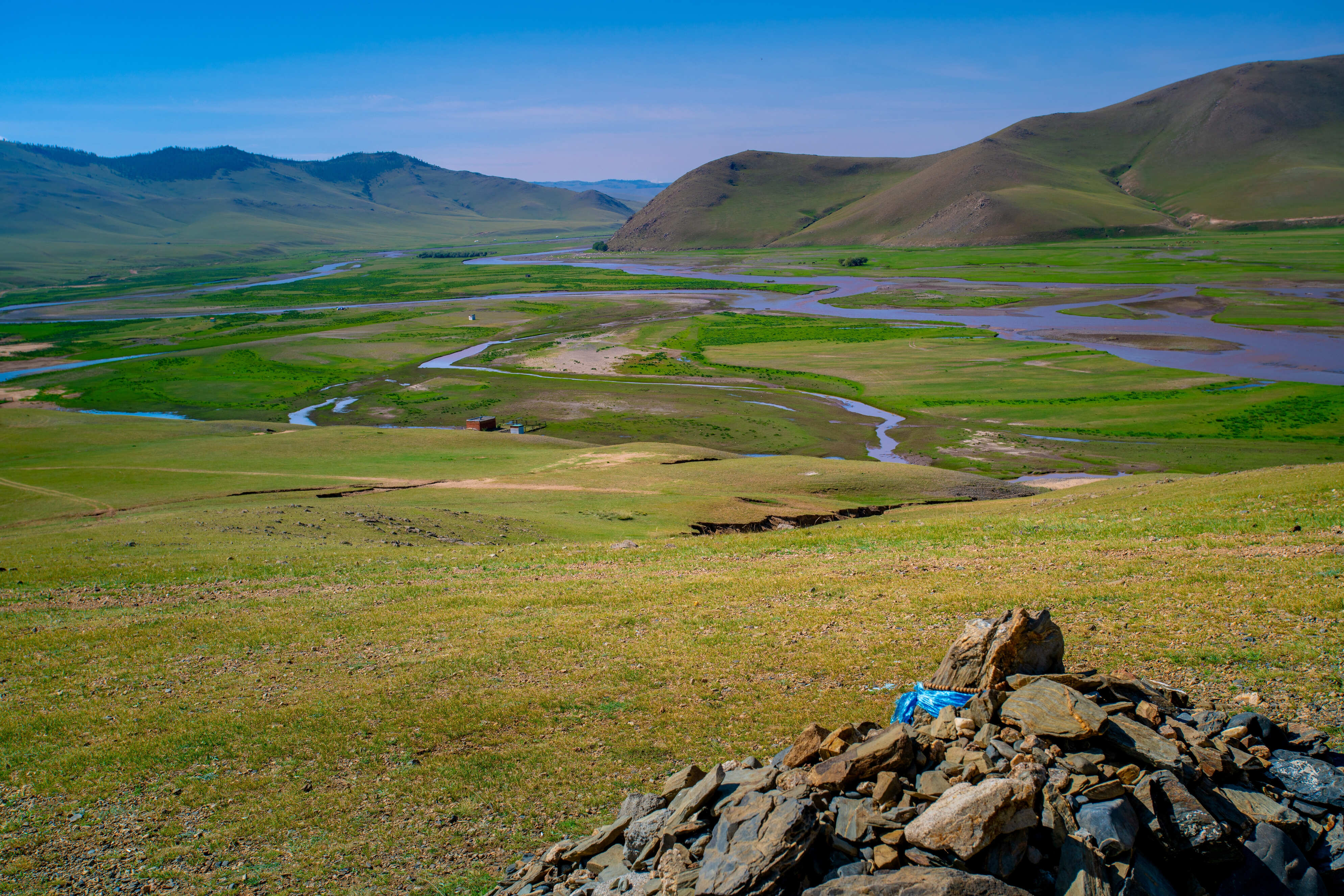
Baldan Bereeven is a monastery of the Gelugpa Buddhist sect, located in the valley of the Baruun Jargalant river in Ömnödelger district, Khentii province. Its name is the Mongolian translation of the Tibetan word "Drepung," meaning "heap of rice," and originally its architecture mirrored that of the Drepung monasteries in India and Tibet.
The site captivates equally through its natural beauty, the monastery surrounded by dramatic and sacred mountains of the Khentii range: Munkh Ulziit, Arvan Gurvan Sansar, Bayan Baraat, and Bayan Khangai. Local beliefs hold that these four peaks embody animal forms: a lion to the east; a dragon to the south; a tiger to the west; and a Garuda to the north. The monastery itself clings to the steep cliff face of Mount Munkh Ulziit, where countless stone sculptures depicting Buddhist deities, mantra inscriptions, and the Soyombo symbol can still be observed.
History
Baldan Bereeven Monastery was founded in 1654 on the initiative of Tsevendorj, a lama who had studied under Zanabazar, Mongolia's First Bogd Gegeen, in Tibet. He sought to create a monastery with architecture modeled on Lumbini, the birthplace of Buddha, to welcome Mongolian pilgrims unable to undertake such distant journeys. At its inception, Baldan Bereeven housed a monastic community of approximately 1,500 monks.
The main temple, called Dash Tsepel Ling, was constructed in the mid-1700s and completed in 1776. The Tsogchin Dugan temple, or "great hall," was finished in 1813 and architecturally replicated the renowned Utai Gumbun monastery in Tibet. The Tsogchin Dugan was among Mongolia's largest structures, measuring 30 meters long by 30 meters wide and nearly 12 meters high.
By 1850, when the main temple's renovation concluded, Baldan Bereeven reached its zenith as a monastic school. It housed four distinct colleges and more than twenty temples where nearly 8,000 monks lived and studied. In the early 20th century, an epidemic decimated more than half the monastic community.
The monastery's tribulations continued. Beginning in 1921 with Mongolia's communist regime, many monks were expelled, particularly during the wave of religious persecution in the 1930s. The government first expropriated the Buddhist church, which lost its independence and faced heavy taxation, before being completely demolished in 1937 during purges orchestrated by Horloogiyn Choybalsan. Most remaining monks were executed and buried in mass graves, or sent to labor camps. The youngest were allowed to return home. Numerous relics were melted down and transformed into bullets used by the Soviet Union during World War II.
Baldan Bereeven Today
The monastery's ruins lay abandoned for nearly 60 years. Following Mongolia's democratic revolution in 1990, a small group of elderly monks who had studied here as children returned to the site. Restoration of several principal temples then began. Today three temples have been restored, and visitors can still see the ruins of approximately 50 temples once erected here, along with stupas and other religious monuments.
Want to discover this destination?
Our local advisors design your tailor-made trip.