Chronology of Mongolian History
Since the presence of the first humans in Mongolia 500,000 years ago, the country has experienced numerous events that have shaped its history. Here is a chronology tracing the most significant facts
Since the presence of the first humans in Mongolia 500,000 years ago, the country has experienced numerous events that have shaped its history. Here is a chronology tracing the most significant facts in the history of the people of the sons of the wind.
Prehistoric Period
500,000 BC: Appearance of humans in Mongolia
4000 BC to 2000 BC: Bronze Age
2000 BC: Herding develops in Mongolia
700 to 500 BC: Transition to the early Iron Age
400 BC: The Chinese people undertake the construction of the Great Wall of China to protect themselves from incursions by the Xiongnu, China's principal enemies.
The Xiongnu and Other Mongolian Empires
209 BC: The first Mongolian empire is established by Modun Shanyui: the Xionghu empire
1 to 100 AD: The Xionghu empire is expelled from China
156: The Hiong-Nu empire is defeated by the Xianbei empire. The latter becomes more powerful in Central Asia
317: The Xianbei conquer Northern China
360: End of the Xianbei empire
386-533: Period of the Northern Wei dynasty, established by the Toba in Northern China
745 to 840: Reign of the Uyghurs, who defeated the Köktürks in 744
840: The Kyrgyz seize power from the Uyghurs
916: Beginning of the reign of the Khitan, established beyond Eastern Mongolia, Manchuria, and Northern China
1122: The Chinese defeat the Khitan currently in power
The Great Mongolian Empire
1162: Temüjin is born; he would later become the famous emperor Chinggis Khan
1189: Temüjin becomes Chinggis Khan (Universal King)
1189 to 1205: Chinggis Khan unites all Mongolian tribes
1206: Chinggis Khan proclaims himself leader of the Mongolian Empire and begins to establish his dominion
1211: Chinggis Khan attacks China
1215: Beijing is defeated and becomes Mongolian
1227: Death of Chinggis Khan
1229: Ögedei Khan, the third son of Chinggis Khan, is proclaimed the second Khan
1231: Invasion of Korea
1235: Karakorum becomes the capital of the Mongolian Empire. Marco Polo arrives there at the same time
1236 to 1240: Period of offensives against Russia by Chinggis Khan's grandson: Batu Khan and his Golden Horde
1240-1480: The Golden Horde establishes sovereignty over Russia
1241: Death of Ögedei Khan
1241 to 1242: Poland and Hungary are invaded by the Mongols
1246: Güyük, son of Ögedei, is proclaimed Khan and subdues Tibet. He dies that same year
1247: Mongolia experiences its first population census
1251: Möngke, nephew of Ögedei, is proclaimed Khan in turn
1251: Defeat of Iran at the hands of the Mongols
1254: Arrival in Karakorum of William of Rubruck, a Franciscan friar sent by Louis IX, then King of France
1256: Baghdad is seized by the Mongols
1259: Death of Möngke
1260: Defeat of the Mongols by the Mamluks of Egypt
1261: Chinggis Khan's grandson, Kublai Khan, is proclaimed Great Khan
1264: The capital is moved to Beijing
1271: Kublai Khan renames his empire the Yuan Empire
1274 and 1281: Attempted invasions of Japan remain unsuccessful
1275: Marco Polo reaches China
1276: Hangzhou, capital of Song China, is annexed by the Mongols
1279: Kublai Khan completes the conquest of Chinese territory by unifying China under his empire. He then creates the Yuan dynasty by toppling the Southern Song dynasty
1294: Death of Kublai Khan
1299: Syria is invaded by the Mongols
1333: Toghon Temür, the last Khan of the Mongolian empire, assumes power of the Yuan empire
1368: The Mongols lose Chinese territory. The Yuan dynasty collapses and the Ming dynasty begins its reign.
Fall of the Empire, Domination by the Manchus
1388: The Chinese destroy Karakorum
1400 to 1454: Mongolia experiences civil war
1409 to 1449: New attacks by Mongolia against China
1466: Dayan Khan unites most of the Mongolian tribes
1480 to 1502: Mongolian control over Russia ends; the Golden Horde falls
1571: The Mongols end 300 years of war with the Chinese
1578: The Mongols convert to Tibetan Buddhism under the reign of Altan Khan. He grants the title of Dalai Lama to Sonam Gyatso
1586: Buddhism becomes the official religion of Mongolia
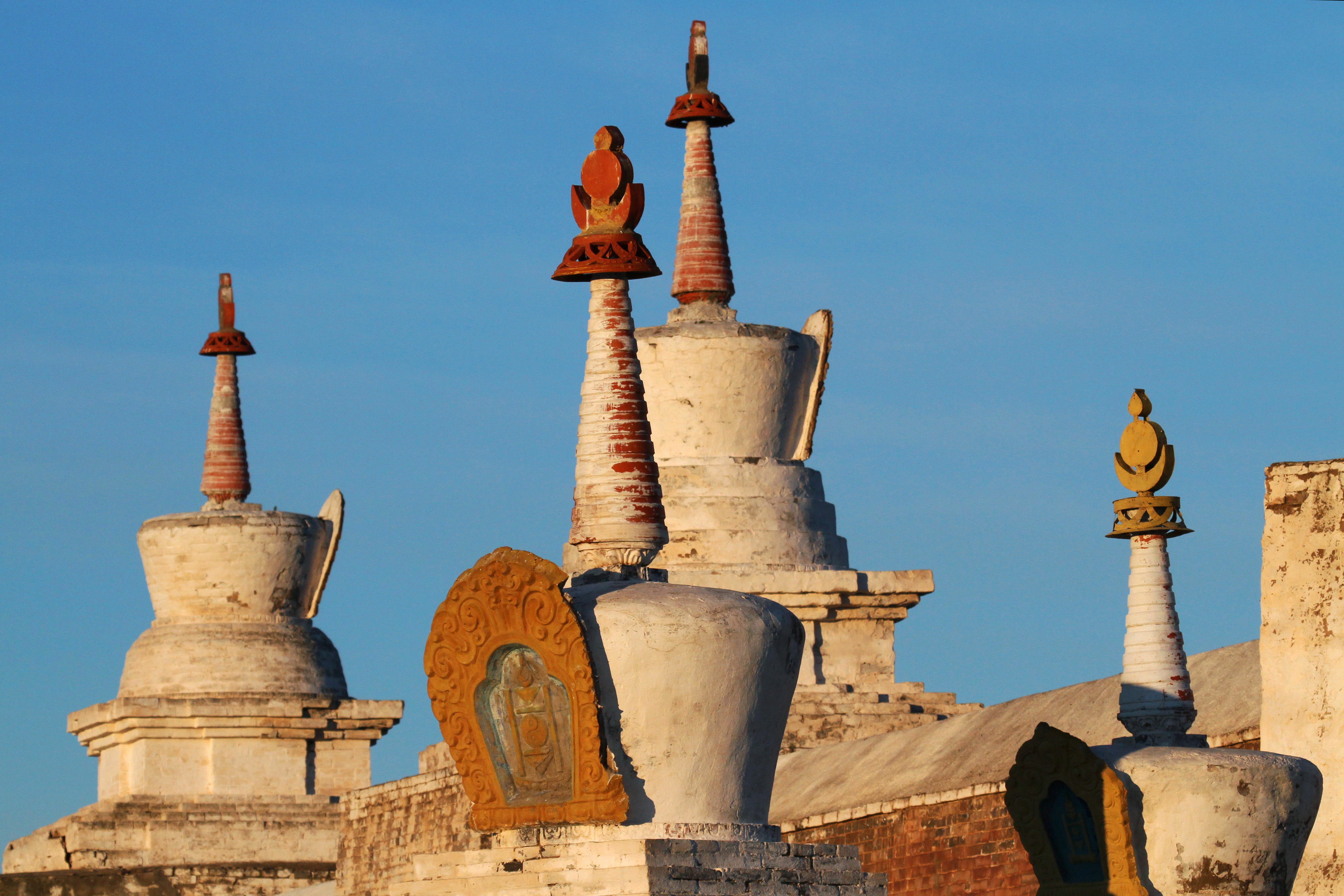
1589: Construction of Mongolia's first monastery begins, Erdene Zuu Monastery
1641: Zanabazar is proclaimed leader of Buddhism in Mongolia
1641 to 1652: The Buryats are defeated by the Russians, who regain control of the Lake Baikal region
1672: Siberia and Russia are invaded by Mongolia
1691: Most of the Khalkha Mongols accept Manchurian sovereignty and are included in the Chinese empire (Qing dynasty 1644-1911)
1728: The traditional borders of Mongolia are redefined by the Sino-Russian Treaty of Kyakhta
1732: End of Mongolia's independence with the defeat of the Dzungar Mongols
1750: China divides Mongolia into two parts: the North becomes Outer Mongolia, and the South becomes Inner Mongolia
1783: The Russians defeat the last reigning descendants of Chinggis Khan
Independence, Socialism, and Democracy
December 1, 1911: Outer Mongolia declares its independence from China
December 28, 1911: Establishment of an autonomous theocratic government by Mongolia
November 5, 1912: China's sovereignty over Mongolia is recognized by a Sino-Russian agreement
May 25, 1915: Russia, China, and Mongolia sign the Kyakhta Treaty guaranteeing Mongolia's independence
September 1918: Outer Mongolia is occupied by Chinese troops
March to June 1920: Formation of the People's Party of Mongolia, which establishes links with the international communist movement
October 1920: Mongolia is invaded by the White Russians
March 13, 1921: Creation of the Provisional People's Government of Mongolia
July 1921: The White Russians are driven from Mongolia by the Russian and Mongolian army
July 11, 1921: Proclamation of a limited monarchy: the People's Government of Mongolia
September 14, 1921: Mongolia's independence is proclaimed by Sükhbaatar
November 5, 1921: The People's Government of Mongolia is recognized by the Soviets
February 22, 1923: Death of Sükhbaatar, revolutionary hero of Mongolia
May 31, 1924: China's sovereignty over Mongolia is recognized by a Sino-Russian agreement
August 1924: The People's Party of Mongolia becomes the People's Revolutionary Party of Mongolia
November 25, 1924: The communists proclaim the Mongolian People's Republic. The country's capital is renamed Ulaanbaatar, the city of the red hero, in reference to Sükhbaatar
December 1928: Khorloogiin Choibalsan becomes political leader
1929 to 1932: Confiscation of feudal property and abolition of religious communities
November 27, 1934: The "Gentlemen's Agreement" between Mongolia and Russia authorizes the entry of Soviet troops into Mongolia
1937-39: The government organizes purges concerning religion
1938: Closure and destruction of Buddhist monasteries
1939: Khorloogiin Choibalsan becomes an undisputed leader
1939: The Japanese are defeated by Russian and Mongolian troops in eastern Mongolia
March-April 1940: Yumjaagiin Tsedenbal becomes general secretary of the party
August 10, 1945: Mongolia declares war on Japan
January 5, 1946: Mongolia's independence is recognized by China
February 27, 1946: Signing of the Treaty of Friendship and Mutual Aid and Agreement on Economic and Cultural Cooperation between Mongolia and the Soviet Union
January 26, 1952: Death of Choibalsan
May 1952: Tsedenbal becomes prime minister
December 1952: Signing of an economic and cultural cooperation agreement with China
July 6, 1960: Adoption of a new constitution
October 27, 1961: Mongolia's admission to the United Nations
January 1962: Condemnation of the "cult of personality" toward Choibalsan
June 7, 1962: Mongolia joins the Council for Mutual Economic Assistance
August 23, 1984: Batmönkh becomes general secretary of the party
December 12, 1984: Dumaagiyn Sodnom is elected prime minister
April 1986: Signing of a long-term trade agreement with China
January 27, 1987: First diplomatic relations established with the United States
March 7, 1989: The Soviets announce the withdrawal of all troops
1992: A new constitution is established as the communists win another election
1996: Against all odds, the democratic coalition defeats the communists in legislative elections
2000: New trend: the communists defeat the democrats in the following election