Customs and Taboos in Mongolia
In the Mongolian ger, life is governed by tradition, and numerous rules and taboos shape domestic behavior. The most common taboos are:
In the Mongolian ger, life is governed by tradition, and numerous rules and taboos shape domestic behavior. The most common taboos are:
- Leaning against or passing between the ger's central poles. This custom undoubtedly has very practical origins, but also expresses the symbolic significance of the poles as sources of strength within the home.
- Stepping on the threshold. It is considered bad luck to step on or stumble over the threshold of the ger upon entering. Travelers in medieval Mongolia reported that anyone who stepped on the threshold of the Khan's palace was put to death.
- Stretching your arms to touch both sides of the doorframe. The cross above the door of the house is traditionally a symbol indicating that a death has occurred and that visitors should keep their distance. Touching both sides of the doorframe by stretching your arms is consequently considered an ill omen.
- Throwing waste into the fire. Fire is considered the purest of all elements, so nothing should be cast into it.
- Mixing dirty and clean items. Mongols hold cleanliness in high regard and believe that allowing dirty objects to touch clean ones will contaminate the latter. According to this custom, it is therefore unacceptable, for example, to place soiled clothing in the family trunk.
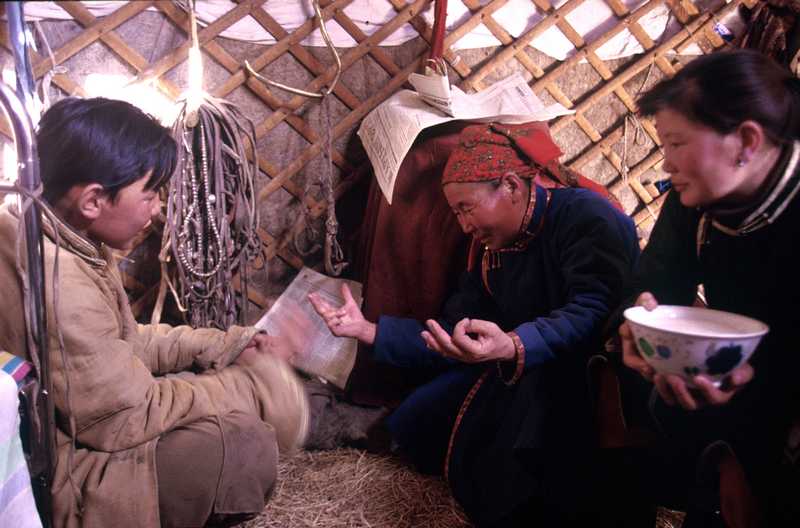
- Walking or sitting to the north of someone older than yourself. While Mongols adhere less rigidly to Confucian values than some other Asian peoples, elders are traditionally accorded considerable respect. The oldest and most respected guests sit at the back of the ger, with others seated beside them in descending order of age.
- Passing between the fire and the back of the ger. The fire and the back of the home are the two most sacred parts of the ger; nomads believe that a line of energy passes between these two points, and it must not be broken. Every visitor should therefore enter and exit from the same side.
- Walking counter-clockwise. The "nar zuv," literally "the direction of the sun's rotation," refers in Mongolia to the clockwise direction. Mongols believe that everything in the universe belongs to the cycles of time and movement, and it is important to move in harmony with these cycles. Thus, when closing the roof of the house, for example, one must walk through the ger in a clockwise direction.
- Bringing weapons into the home. Before entering the house, the visitor must remove his knife from his belt and hang it in plain sight, thereby signaling peaceful intentions.
Other customs govern the way guests are received. Mongols generally show great respect to visitors and will welcome anyone into their home without prior appointment. When a visitor arrives, they must call "nokhoi khor!" which means "Hold your dog!" whether or not there is actually a dog present. Someone from the family will then come out of the ger and invite you in. The three main types of reception are tsailaga, budaalaga, and dailaga; literally offering tea, offering rice, and offering dinner. The tsailaga custom is the most widespread and is followed when someone respectfully offers tea to a visitor, relative, or friend; when a nomadic family has just settled and wishes to meet its new neighbors; or during any celebration. Budaalaga and dailaga are similar but show greater respect for the visitor.