The Mongolian Language
The Mongolian language belongs to the Ural-Altaic language family, which includes Turkish, Kazakh, Uzbek, Finnish, and Korean.
The Mongolian language belongs to the Ural-Altaic language family, which includes Turkish, Kazakh, Uzbek, Finnish, and Korean.
Mongolian is agglutinative. That is, words are formed by cumulatively adding suffixes to a root.
All Mongolian words are either masculine ("hard") or feminine ("soft"), depending on the vowels they contain: А, У, and О are masculine vowels, while Э, Ү, and Ө are feminine. All words can contain only masculine or only feminine vowels.
Several aspects of the language's evolution can be observed through the traditional Mongolian script (Uighur), which has preserved the spelling corresponding to what Mongolian must have been several centuries ago. Once, the language followed a pattern alternating vowels and consonants, but in modern Mongolian syllables were dropped, leading to an increase in consonant clusters. Moreover, long vowels were formed as a result of the elimination of consonants—for example, the word Khan (the king) is based on the ancient term "khagan" (kha'an).
The traditional Mongolian script originated in the ninth or tenth century and is based on the Uighur alphabet. It was not until the 12th century, however, that it became the official writing system. The oldest known example of Mongolian script is the "Stone of Genghis," a monument that Genghis Khan had erected in 1224 in honor of Prince Yesünge, who shot an arrow a record distance (335 ald) during celebrations held to commemorate an important military victory.
After the Mongolo-Uighur script, other forms of writing were introduced and used in Mongolia. The first of these was the square alphabet, which Kublai Khan had formulated by the Pagma Lama in Tibet in order to increase the level of literacy throughout the Yuan empire. Named "the new script," manuals were distributed to schools, and by the late 1260s, tax revenue was directed to individuals enrolled in language courses using the new alphabet. A decree required all official orders issued from monasteries (1270) and from the government (1273) to use this alphabet. Despite its ambitious intentions, the square alphabet failed to supplant other forms of writing in use throughout the empire.
A new alphabet called tod, or "clear script," was developed in 1648 by Zaya Bandida and offered a variant to Uighur writing. This alphabet aimed to resolve one of the problems of Mongolian script: a letter could have two or more possible sounds. Its purpose was therefore to align spoken language and written language, which had become markedly different after several centuries of stagnation in written language. The new script was called "clear" because, unlike Uighur script, it made a clear distinction between each of the seven vowels and between pairs of consonants that, in the old alphabet, shared the same character (the g-h, d-t, and so on). Several manuscripts were written using tod characters, but the use of this revised script never became widespread.
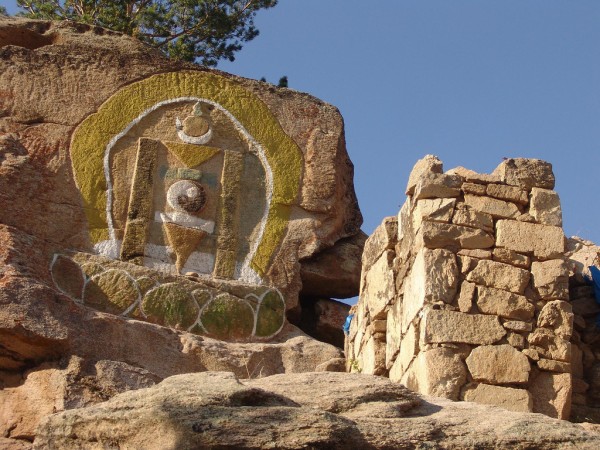
An important form of script used in the translation of religious sutras was the "soyombo" alphabet, designed by Undur Gegeen Zanabazar. This alphabet contained 90 letters reflecting Khalkha pronunciation. It made it possible to accurately transcribe Sanskrit, Tibetan, and Mongolian languages. The Manchu script is a new development derived from Mongolian script. Norkhatsi Erdene and his assistant Gagai created this alphabet together in 1599, having been tasked with developing a script based on Mongolian.
Although nearly all Mongols used the old script (Uighur) until 1940, in 1946 the use of the Cyrillic alphabet became official in the Mongolian People's Republic. Before that, in the 1930s, it had been decided to adopt the Latin alphabet, and some books and newspapers had used Latin characters in their publications; this project was ultimately abandoned.
In 1990, the government first attempted to re-adopt the old script as the official writing system in Mongolia, but with little success. The classical alphabet is still used in Inner Mongolia.