Traditional Mongolian Clothing
Mongolian national costume consists of the deel, a hat, boots, and accessories. Although there are some differences between the costumes of various Mongolian ethnic groups, all deels follow the general pattern.
Mongolian national costume consists of the deel, a hat, boots, and accessories. Although there are some differences between the costumes of various Mongolian ethnic groups, all deels follow the general pattern.
The modern deel features long sleeves, a wide flap that folds across the chest with buttons on the right side, a high collar, and a fabric belt cinched at the waist. For men, the working deel is traditionally made of thick cotton or wool, while that of women is more luxurious, featuring silk prints. Winter deels are lined with sheepskin or goatskin.
The traditional hat can be made of fur, silk, felt, or other materials depending on different styles.
Boots are typically crafted from leather with thick felt lining.
Many herders make and wear their own deels and boots, though increasingly Mongols are adopting Western styles. Nowadays, most city dwellers wear traditional Mongolian costume only for celebrations, such as Tsagaan Sar (New Year), or special occasions, such as graduations or weddings.
The earliest known form of Mongolian dress was worn by the Huns, whose costume consisted of a deel with a front flap, pointed boots, and a belt. The Turks, who populated Central Asia from the sixth to tenth centuries, wore similar clothing, though the front of the deel was fastened in the opposite direction. It was only from the 13th century onward that Mongolian costume became more refined, with silk beginning to replace wool and leather. The high collar and front flap of the modern deel appeared relatively recently, dating to the period when Manchuria dominated Mongolia. Before that time, the front of the deel was crossed diagonally, as Mongolian lamas still wear it today.
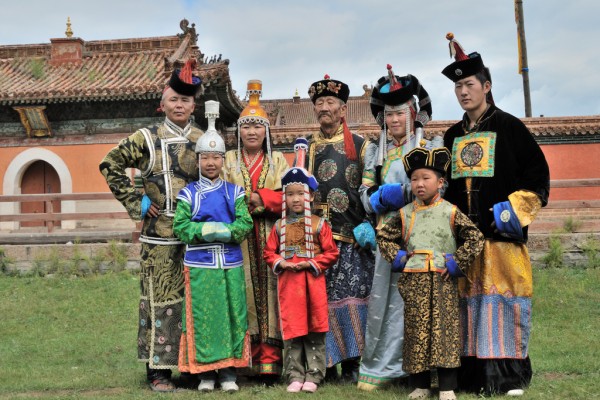
From the early twentieth century, it became common for women to wear elaborate and richly decorated garments as well as fine jewelry to display their social status. A Khalkh chief's wife's deel, for example, was crafted from worked silk and featured wide gold or silver brocade. Over this deel, she might wear an uuj, or sleeveless robe, in a different color.
For jewelry, she favored pendants made of coral, jade, pearls, or other precious stones, with pearls considered the most precious material, followed by coral and silver.
Hair was typically flattened and pinned high in a veil finished with silver decorations.
Following the communist revolution, such richly decorated clothing was declared illegal as it symbolized the wealth of the feudal classes. Beyond the simplification of women's dresses, Western hats and caps replaced traditional Mongolian hats, men cut their hair queues, and women had their hair cut for the first time.