Setting Up a Yurt
A yurt could be briefly described as a round tent covered with felt and a durable, waterproof white canvas.
A yurt could be briefly described as a round tent covered with felt and a durable, waterproof white canvas.
The Mongolian yurt has two main components: the wooden frame and the felt covering. The wooden frame is known as khana, the central columns that support the yurt are called uni, and the crown through which smoke escapes is the toono. 88 wooden branches, each measuring approximately 1.5 metres, are used for the yurt's frame, with just two central columns supporting the entire structure. Once the frame is erected, it is covered with felt and mounted on a wooden floor or directly on the ground. The door is always oriented towards the south side, facing the sun, providing more light to the heart of the home.
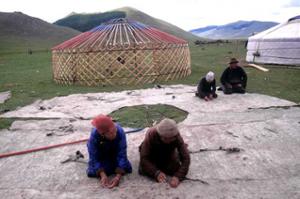

Nomads make their felt in a completely handcrafted manner. Spring is the shearing season, when sheep still have their winter wool. The tangled wool is laid out on a tarp on the ground, beaten, matted, and sprayed with water. The tarp is then rolled over the wool and tied to an axle that is pulled by a horse. After a few hours of this treatment, the nomads have their felt.
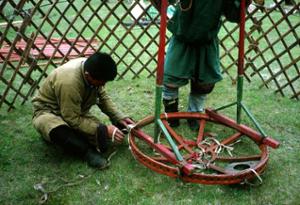
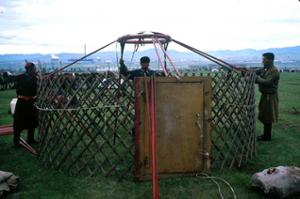
The felt (esgii) is obtained in sheets that are sewn together to create the panels used to cover the yurt. A total of 7 felt panels are needed to cover the yurt—3 for the roof and 4 for the walls. The toono is the crown on the roof, at the centre of the yurt. It is also the only part of the yurt that remains uncovered and where the chimney emerges. The 88 wooden poles of the yurt extend from the toono to the walls of the yurt, supported by the 2 central columns (bagana) located in the centre of the yurt.
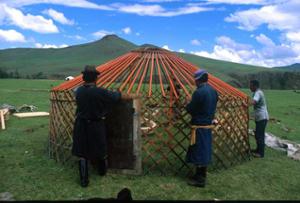
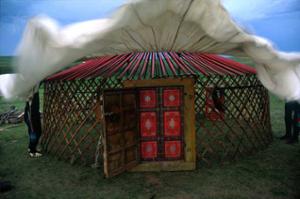
Once the 5 walls (khana) and the door (khaalga) are mounted, they are attached using ropes (ujas)... then the walls can finally be connected to the toono using the 88 uni, or wooden branches that form the frame of the yurt's roof, upon which the felt will rest.
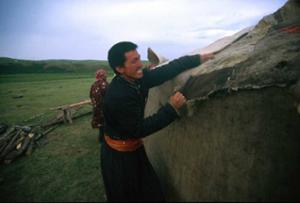
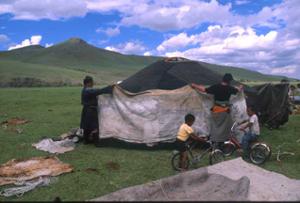
A first lining called dotuu burees is installed on the wooden roof structure. This is made from white cotton. The different panels of felt are then laid on the yurt. Mongolian felt has waterproof qualities and dries quickly.
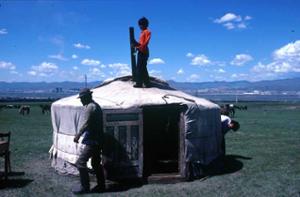
Finally, the felt section is covered with a waterproof canvas or synthetic covering, called the brezent. Your family yurt is now complete—until the next migration.