Nomadism in Mongolia
Traditional Mongolian life is based on the herding of five types of animals: livestock (including yaks), sheep, goats, camels, and horses. The products obtained from these animals
An existence built on herding
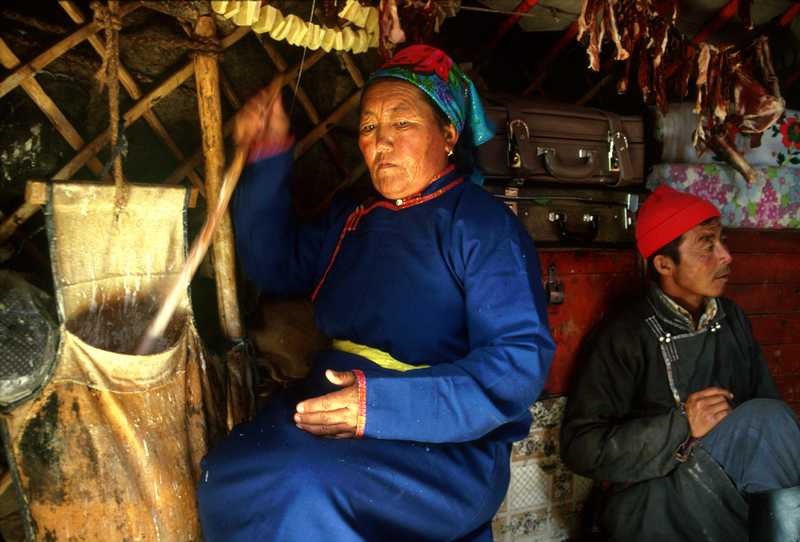
Traditional Mongolian life is based on the herding of five types of animals: livestock (including yaks), sheep, goats, camels, and horses. The products obtained from these animals satisfy nearly all of a family's primary needs:
- beef, mutton, and goat meat complemented by a wide variety of dairy products form the Mongolian diet
- sheep's wool, transformed into felt, is used to make clothing, bedding, and insulation for yurts
- horses, camels, and yaks are used for transportation
- and even animal hair and bones are used to produce musical instruments and toys for children
The domestication of animals and the emergence of the nomadic lifestyle arrived relatively late in Asian history, long after agricultural techniques had appeared. In many respects, herding practiced by nomads is more complex than agriculture. Indeed, it requires the ability to domesticate animals, to control their feeding and breeding, and to develop expertise in transforming animal products into food, clothing, and shelter. Nomadism also demands a thorough understanding of natural cycles and an appropriate selection of pastures to meet the needs of each type of herd.

The migrations
The movements of Mongolian herders are not conducted at random, but according to precise traditions. Mongolian nomadic families change their animals' pastures with each of the four seasons, named Uvuljuu (winter pastures), Khavarjaa (spring pastures), Zuslan (summer pastures), and Namarjaa (autumn pastures). During winter and spring, herds are generally kept in one location to preserve their strength, but during summer and autumn, the family will move their herds several times to reach larger pastures, allowing animals to gain weight more easily by grazing on fresh vegetation. During the hottest months of the year, herders leave behind many of their possessions, traveling in a smaller, lighter yurt with minimal furniture.
In the forested regions of the steppe, where precipitation is more abundant, families migrate between six and eight times per year, covering an average distance of 15-20 kilometers. In the mountainous and arid regions of the steppe, the distances traveled are longer, and nomadic families may migrate up to 150 km from their initial location. Nomadic practices in the Gobi are directly influenced by climatic conditions and the location of water sources; extreme drought or snowfall can force families to travel great distances in search of sufficient water and pastures. For winter pastures, a sheltered enclosure is erected, and animals are kept protected and insulated by a layer of dried animal dung. In spring, the period when animals are weakest, the family moves to pastures where the first shoots are emerging and which are free of rocks, marshes, or slippery areas that could further weaken the animals.
The most frequent movements occur during the summer months, when the family brings its herds to areas with abundant vegetation. By autumn, as animals need to gain weight to prepare for the harsh winter, they are moved to quiet locations—far from roads or settlements—where they can graze in peace.
Migrations from one pasture to another are considered important events and are accompanied by ceremony. Before the move, the head of the family dons his finest clothes and rides his best horse in the middle of the day to examine the new pastures. Once a suitable location is chosen, he places three stones on the ground, symbolizing a hearth, to mark the future site of each family yurt. The family then selects an auspicious day for migration and begins packing domestic items in preparation for the move. The migration itself is governed by custom. It is considered extremely unlucky for a quarrel or any disturbance to occur during the migration or its preparation. On departure day, the family yurt is dismantled and all possessions are loaded into carts, with the most valuable items—the hearth and roof frame, the chest, religious icons, and the head of the family's personal belongings—placed in the lead cart. Along the way, many families will invite passing nomads in for tea, and once their new camp is established, the family will invite their new neighbors.