Mongolian Food
As Mongolia is a society based on herding, the traditional Mongolian diet consists of food that can be obtained from five primary domesticated animals: cattle, goats, sheep, horses, and camels
As Mongolia is a society based on herding, the traditional Mongolian diet consists of food that can be obtained from five primary domesticated animals: cattle, goats, sheep, horses, and camels (See nomadism).
The traditional diet is therefore high in calories and fat, which enables Mongols to withstand the harsh winters. Mongols typically eat only one full meal per day, in the evening; during the day, however, they consume large quantities of milk tea. This tea is often mixed with rice, flour, or even pieces of meat to give it more substance, or accompanied by small fried cakes (boortsog). The evening meal includes meat that is traditionally boiled and often served with noodles made from flour and water.
In the past, Mongols likely obtained their flour from wild grains, but from the Middle Ages onward, barley and wheat flour were extensively imported from neighboring countries. The so-called "fine foods," traditionally prepared for holidays or special occasions, require more preparation time than basic dishes: they include meat dumplings, boiled or steamed (bansh, buuz), chow-mein noodles (tsuivan), and fried meat crepes (Huushuur). Mongols have long supplemented their diet with wild herbs, vegetables, and berries.
In the twentieth century, under Russian influence, the use of edible roots increased substantially. The meat consumed in the contemporary Mongolian diet is typically mutton, beef, or goat. Mongols never slaughter young animals, preferring meat from mature animals. Mutton is considered the finest meat, with the hind quarters being the most prized; during holidays or important ceremonies, a whole sheep is prepared and boiled. The hind quarters of the animal are placed on a plate at the head of the table. Horse meat is normally eaten in winter due to its caloric value. Camel meat, which was traditionally never consumed, has also found its place in the Mongolian diet.
Historical sources also indicate that in centuries past, extensive hunting provided another source of meat. Elk, wild boar, bear, gazelle, and wild sheep and goats were all sources of meat. Although meat is traditionally boiled, two other less common methods exist. Boodog, which is commonly used to cook marmot, involves removing the bones and entrails of the animal while carefully preserving the skin and meat intact. Hot stones are then placed inside the animal's body, and the meat cooks through this method. To prepare Khorkhog, the animal's meat is cut into pieces and placed in a container that also contains hot stones, and the container is heated over an external heat source. Khorkhog was an ordinary cooking method used by soldiers during military campaigns in centuries past. Large animal meat such as deer or gazelle could cook in its own stomach, eliminating the need to transport heavy and cumbersome pots.
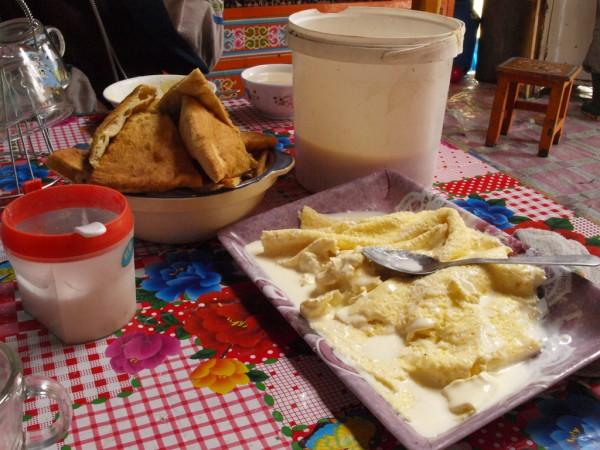
The Mongolian diet also includes numerous forms of dairy products. Cow's milk is never consumed raw due to the risk of brucellosis infection. It is therefore either consumed boiled and diluted with water, or as yogurt (Tarag) or used in milk tea.
Mare's milk does not need to be boiled and is primarily consumed for therapeutic purposes. Indeed, this milk contains far more vitamins than other dairy products. However, it is more commonly consumed in its fermented form, airag (Khoumis).
Other basic dairy products include cheeses (Byaslag), dried curdled milk (aaruul), cream (Zuukhiit), butter, and various forms of butter fat.
During the summer months, Mongols traditionally eat very little meat and instead consume dairy products, believing that this diet purifies the body. Herding families rarely eat fresh meat in summer and content themselves with dairy products and salted or dried meat prepared earlier in the year.
Airag (koumiss), fermented mare's milk, constitutes an important part of the summer diet. To make the beverage, a portion of airag from a previous batch is used as a starter. In winter, this portion is frozen and then dried in a fabric bag that will be used the following summer. This base is then mixed with cow or goat milk, the mixture is heated before being left to rest. Finally, fresh mare's milk is gradually poured into this mixture and the airag is vigorously beaten in a cowhide bag until it ferments. Although airag is slightly alcoholic, strong alcohols have not historically held an important place in Mongolian life. Indeed, in traditional society it was important to drink in moderation. The rule transmitted from the time of Kaboul Khaan was:
"At forty years you may taste; at fifty years you may take small sips; at sixty years you may enjoy a few pleasures".
In other words, a person who had not yet reached their fortieth birthday was not yet permitted to drink alcohol. According to the "Ikh Zasag," the law established by Genghis Khan, anyone reporting to work after drinking would be stripped of his weapon; if he repeated the offense, he would lose his horse; if he did so again a third time, one of his extremities would be cut off, and finally, the fourth time he would be exiled. From the twentieth century onward, however, under Russian influence, vodka consumption increased significantly. Drinking vodka during holidays and celebrations thus became an element of modern culture.