5 Cultural Blunders to Avoid in Mongolia
When living or traveling abroad, behaviors and expressions often carry different meanings than in our home country. Without meaning to, we risk embarrassing our hosts or worse. Here are five mistakes to avoid when you visit Mongolia.
When living or traveling abroad, it's common for certain behaviors or expressions to carry meanings quite different from those in our home country. Without intending to, we risk embarrassing our hosts—or worse, insulting them. Here are five mistakes to avoid during your time in Mongolia.
I've Stolen Your Nose—Where Is It?
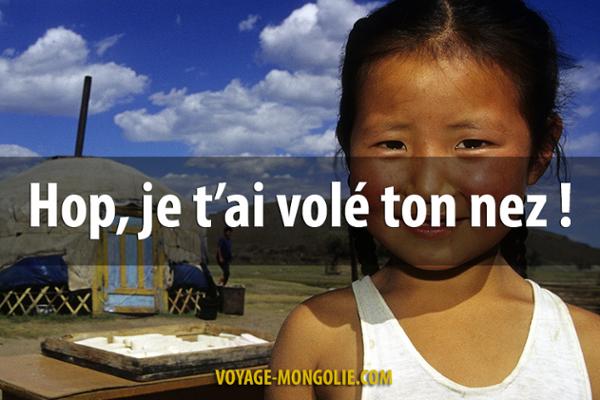
I'd say this is the most embarrassing mistake you could make—yet all you're trying to do is have fun with a child. Who hasn't played the nose-stealing game, pretending to pull a child's nose and then revealing it between thumb and forefinger? Do this with a Mongolian child, and you'll face the fury of the parents and shock everyone around you. In Mongolia, this gesture—thumb inserted between index and middle finger—carries an entirely different and highly offensive meaning. It's essentially the Mongolian equivalent of raising your middle finger.
I once played this game with a young Mongolian, and believe me, it was the last time!
Thank You, Thank You, Thank You!

English-speaking travelers tend to be polite—perhaps overly so by Mongolian standards. We say thank you repeatedly when a nomadic family offers us a cup of milk tea, gives us a piece of dried curds, or serves us a meat dish. Nothing offensive, you'd think—but you'd be wrong.
The Mongolian language makes far less use of politeness formulas. Generally, you thank your host family only once—for example, before leaving—and the gesture should accompany the word, perhaps with a small gift. Mongolians view service as part of a reciprocal relationship. Frequent thanks would disrupt this balance. In essence, saying thank you repeatedly can seem almost impolite, as it suggests you don't intend to return the favor.
More broadly, Mongolians expect service to be repaid with service in kind. Excessive gratitude breaks this cycle of reciprocity.
Driver, When Do We Arrive?
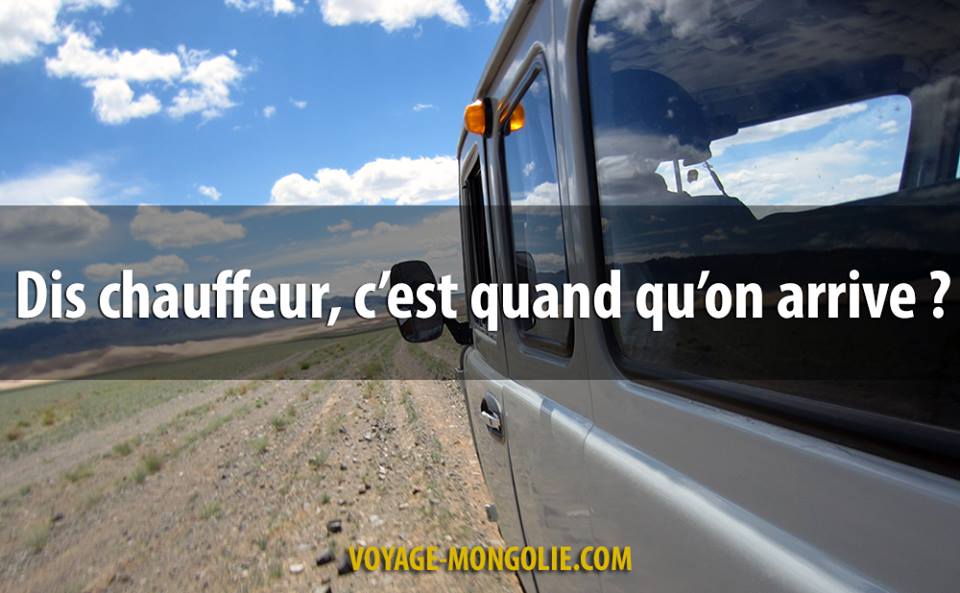
Roads in Mongolia can be long, and travelers are often curious. You want to know how much driving remains, what time you'll arrive—the question burns on your lips, and you ask your guide. Then comes the surprise: your guide doesn't relay the question to the driver. Instead, they give you a vague answer: "soon" or "in a while."
How can it be that the guide and driver accompanying you don't even know when you're supposed to arrive?
Rest assured, they do know—but in Mongolia, stating such things directly is considered very poor form. It's called "speaking white," and locals fear it will bring bad luck. By saying "we'll arrive in one hour," the guide and driver believe they're inviting misfortune—a flat tire, engine trouble—that will prevent you from arriving on time.
Be patient, then, and take the journey as it comes. If curiosity overwhelms you, try indirect questions like "How many kilometers do we have left?" and do the math yourself.
One Sheep, Two Sheep, Three Sheep...

Here's another question travelers naturally ask nomadic herders, one that creates the same awkward situation: "How many animals make up your herd?"
An innocent question, you'd think—but no. For the same reason as before, the Mongolian herder believes that announcing the exact number of animals they own ("speaking white") will invite bad luck, causing one of their animals to die. Their answer will remain vague to such questions, which they find inappropriate.
Oh No, We'll Never Cross This River Ford!
Foreign travelers love to exclaim and joke during journeys. So when seeing a massive river crossing, it's natural to cry out: "There's no way the vehicle will make it! We'll get stuck in the middle of the river!"
Funny—but not to your team, for whom such an outburst is an example of "speaking black."
In Mongolia, it's not only considered poor form to boast, but it's also inauspicious to voice negative predictions about what might happen, for fear of—once again—inviting bad luck upon yourself.
Should you actually get stuck in the river, and you've made such a prediction, your driver may well hold you responsible!
I admit it's not easy, and we're not asking you to monitor every word you speak—after all, our English-speaking guides are accustomed to European quirks! But I hope this helps you understand certain reactions from the Mongolians you meet during your journey. Remember: the Mongolian way is often the middle path. You don't go well or poorly, but gently. So take your time, and savor this remarkable Mongolian culture.