Taikhar Rock
Taikhar Rock
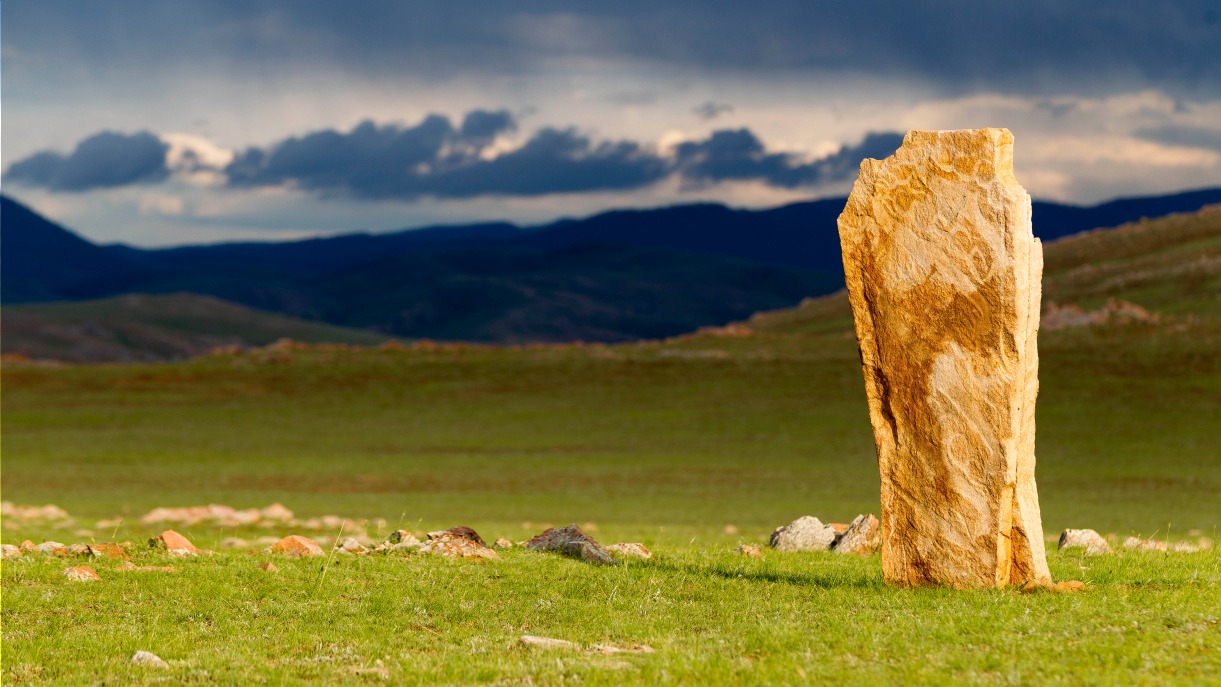
A 20-meter granite boulder on the banks of the Khoyd Tamir River, covered with runic, Sogdian, Uyghur and Mongolian inscriptions, 22 km from Tsetserleg.
The Taikhar Rock is a 20-meter-high granite boulder standing on the banks of the Khoyd Tamir River in Arkhangai Province. Its surface bears inscriptions carved over more than a millennium, in six different scripts, testifying to the civilizations that have crossed the region since the ancient Turkish period.
Why Visit Taikhar Rock
The site combines three interests rarely found on the same rock outcrop. From an archaeological perspective, it brings together approximately 150 inscriptions in runic, Sogdian, Uyghur, Mongolian, Nangiad (Chinese) and Tibetan scripts, making it a unique epigraphic stratigraphy in central Mongolia. The oldest, in Old Turkic runic, dates back to around the 8th century.
From an ethnographic standpoint, an ovoo crowns its summit, perpetuating the use of the rock as a sacred site in shamanic tradition. From a landscape perspective, finally, the rock stands out in the middle of an open plain crossed by the river, in a setting representative of the Arkhangai steppes.
History and Inscriptions
Taikhar Rock has been used as a carved surface since the period of the Turkish khaganates (6th-8th centuries), when the Orkhon runic script served the Turkish elites of the region. Later inscriptions follow waves of occupation: Sogdian along trade routes, Uyghur after the collapse of the Turkish khaganate, then Mongolian, Chinese and Tibetan as the region came under successive cultural spheres.
Together they form an open-air archive, studied by Mongolian and foreign epigraphists since the 19th century. The site has been designated for government protection since 1994. Several years of graffiti have, however, severely damaged the ancient inscriptions, much of which is no longer legible to the naked eye today.
Legends of the Rock
Three popular tales surround the site. According to the first, Bukhbilegt, a giant warrior, is said to have thrown this rock onto a serpent emerging from the earth, explaining its isolated presence in the middle of the plain.
The second features two lovers, Tamir, a young woman from the region, and Taikhar. Prevented from uniting by the local lord who wished to marry Tamir, they fled in opposite directions. Tamir headed toward the river. Taikhar, waiting for her along the watercourse, is said to have eventually transformed into a rock, fixed for eternity without ever being able to reach her.
A third tradition holds that whoever manages to throw a stone to the top of the rock will become wealthy. You will see many small pebbles accumulated on intermediate ledges, evidence of past attempts.
What to See On Site
- The rock itself: a complete walk around takes about twenty minutes and allows you to identify zones with still-legible inscriptions, particularly on the south and east faces.
- The summit ovoo: a ritual stacking of stones and wood adorned with blue fabric (khadag). Tradition dictates walking around it three times clockwise.
- The banks of the Khoyd Tamir: the river flows a few dozen meters south of the rock and offers an interesting vantage point for photographing the entire site.
- The surrounding steppe: ger camps, herds of yaks and horses compose a landscape typical of Arkhangai.
Practical Information
Visits are free and open, with no guardianship or ticket office on site. Allow 30 minutes to 1 hour to walk around the rock and read the explanatory panels (in Mongolian and English) installed nearby. The site is accessible year-round, but the road becomes difficult between November and April due to snow and ice. The best period extends from June to September, with mild temperatures and verdant grasslands.
No facilities (dining, accommodation) exist at the foot of the rock: bring water and snacks. Several tourist ger camps can be found on the road between Tsetserleg and the site.
How to Get There
The rock is located 22 km northwest of Tsetserleg, the capital of Arkhangai, on the territory of the Ikh Tamir village. From Tsetserleg, plan for approximately 30 to 45 minutes of driving, partly on track. From Ulan Bator, access is via the main Arkhangai road: allow a full day of travel (approximately 470 km).
A 4x4 vehicle with driver is recommended, as signage is limited and the final section is unpaved.
What to See in the Area
Taikhar Rock fits naturally into a circuit through Arkhangai and the Orkhon Valley. Nearby, you can combine your visit with:
- Tsetserleg and its Zayain Gegeenii Süm monastery, the region's logistical base.
- The Turkish memorials at Khöshöö Tsaidam, another major site of runic epigraphy in Mongolia.
- The Tövkhön Monastery, perched in the mountains to the south, founded by Zanabazar.
- The Gunj Temple, a discreet monastic complex in the Orkhon Valley.
To plan a complete itinerary including Taikhar Rock and Arkhangai sites, consult our custom Mongolia trips.
Interested in this visit?
We can include it in your personalised itinerary.