Central Steppe and Ulaanbaatar
Capital at 1,350m elevation, active Gandan monastery, Terelj park at 1h30 and Przewalski horses at Hustai: the pivot of every Mongolian journey.
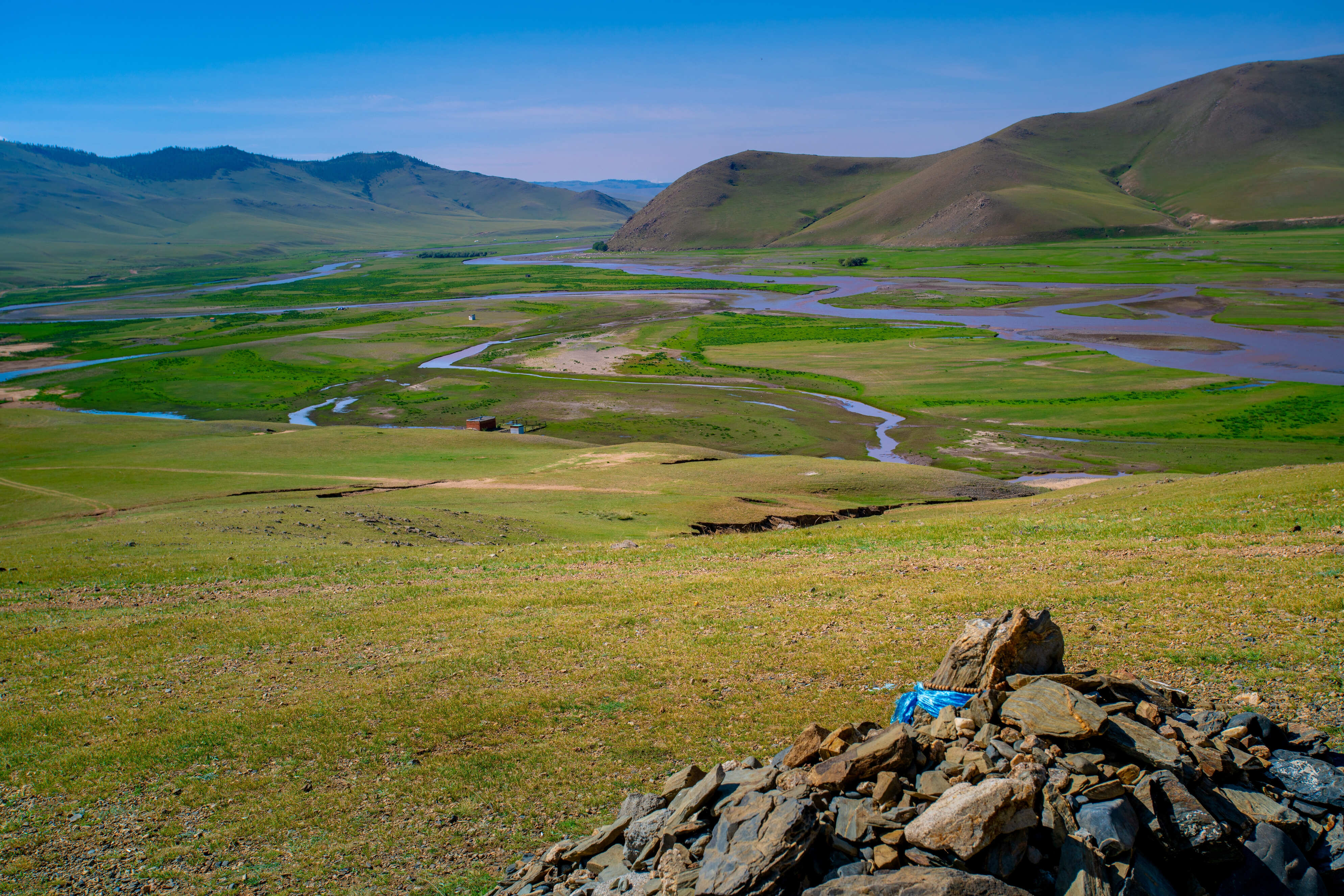
The central steppe forms the historical and demographic heart of Mongolia. Ulaanbaatar, perched at 1,350 metres altitude in the Tuul valley, concentrates 1.5 million inhabitants—nearly half the country's population. Our agency is based here, a short distance from Gandan monastery, the main centre of Mongolian Tibetan Buddhism still in active use, where recitation services begin around 9am in the Migjid Janraisig temple.
The city blends 1950s Soviet apartment blocks, recent glass towers financed by mining revenues, and ger districts (yurt quarters) that ring the hills to the north. The contrast tells the story of rapid transition from a pastoral economy to a tertiary capital. Before heading out on circuit, two stops seem essential for orientation: the National Museum of Mongolia, which traces the Xiongnu sequence, the Genghis Khan empire, the Qing period and 20th-century communism, and the Zaisan memorial to the south, from where you can grasp in a single glance the city's grip on the valley and the steppe's arrival at its edges.
As for dining, Ulaanbaatar is the only place in the country where you find real culinary variety before long regional stretches. You eat buuz (steamed mutton dumplings) and khuushuur (fried pastries) in neighbourhood canteens, but also Korean, Georgian, Indian cuisine, and a few modern tables reworking local products—yak meat, sea buckthorn berries from the Selenge, dried aaruul cheeses. The Naran Tuul and Mercury markets let you buy felt boots, deel (traditional coats) or Gobi cashmere at reasonable prices.
Fifty-five kilometres east, on the road to Terelj, the equestrian statue of Genghis Khan at Tsonjin Boldog rises 40 metres of stainless steel above the steppe. Opened in 2008, the site hosts a museum and viewpoint installed on the horse's head. It also marks the shift towards the landscapes that define the region: rolling grass plains, herds of wild horses, and the first granite formations.
Gorkhi-Terelj National Park, 1h30 drive from the capital, spreads its 2,900 km² between larch forests, flower-filled meadows in June-July and rocky chaos like Turtle Rock (Melkhii Khad) or the Valley of a Hundred Monks. Several ger camps welcome travellers, and herding families open their ger to share a bowl of suutei tsai (salted milk tea). This is where your first Mongolian horse rides happen, on small, enduring mounts, ridden using a technique different from European horsemanship.
Further south, Hustai reserve harbours Przewalski horses, or takhi, reintroduced since 1992 after their disappearance in the wild. Observing them requires patience in late afternoon near water points. The region also includes Kharkhorin, the former imperial capital and site of Erdene Zuu monastery founded in 1586, which we attach more to the Orkhon valley in our itineraries.
To discover
Gandan monastery at dawn. Morning service in the Migjid Janraisig temple, around a 26-metre golden statue rebuilt in 1996. Monks chant in Tibetan while the faithful spin prayer wheels on the courtyard.
Gorkhi-Terelj rocks. Trails between rounded granite blocks of Turtle Rock and edelweiss meadows. Night in ger camp with wood stove, at 1,600 metres elevation.
Przewalski horses at Hustai. Twilight observation of takhi, the last genuinely wild horse species, on the grassy slopes of the park located 100 km west of Ulaanbaatar.
Genghis Khan statue at Tsonjin Boldog. Lift ride up through the horse's mane to reach the summit platform, 30 metres above the steppe. The museum displays objects from the Xiongnu period and the Mongol empire.
Ulaanbaatar markets and canteens. Steamed buuz in neighbourhood guanz, and cashmere stalls at Naran Tuul market. Good opportunity to buy any missing gear before remote regions.
When to visit
Ulaanbaatar is the world's coldest capital on average annual basis. From December to February, temperatures regularly drop between -25°C and -35°C, with air pollution cover from coal heating in ger districts making the air difficult. March and April remain cold and windy, with possible dust storms. October is dry and luminous but nights drop below zero from mid-October.
The comfortable window runs from mid-June to early September, with daytime temperatures between 20°C and 27°C and nights around 10°C on the steppe. July concentrates rain (around 75mm over the month) and the national Naadam festival, 11–13 July, which makes Ulaanbaatar very lively but saturates accommodation. August generally offers the best weather trade-off, with August-early September also being the season of colours in Terelj larches.
Practical advice
We recommend 2 to 3 days on site: one day for the city (Gandan, National Museum, Zaisan, a market), one day for Terelj with a stop at the Genghis Khan statue, and possibly one day for Hustai. Beyond that, interest fades quickly and the steppe is better experienced in more remote regions. Chinggis Khaan international airport, opened in 2021, sits 50 km south of the capital; allow 1 hour for transfer.
The region serves as logistical hub for all combinations: departure to the Gobi Desert by internal flight or 4x4 (2 days of dirt road), to the Orkhon valley via paved road to Kharkhorin (380 km, 6 hours), to Khövsgöl Lake by flight to Mörön then road, and to Mongolian Altai by flight to Ölgii. Comfort in Ulaanbaatar reaches international standard in several city-centre hotels, making it a good recovery stop between ger segments. The region suits all traveller profiles, including families with children, contemplatives wanting to understand the country before the steppe, and riders doing their first saddle hours at Terelj before longer stages.