Gobi Desert
A semi-arid steppe rather than a sea of sand, the Mongolian Gobi blends 300-meter dunes, dinosaur cliffs, an icy canyon and families of cashmere goat herders.
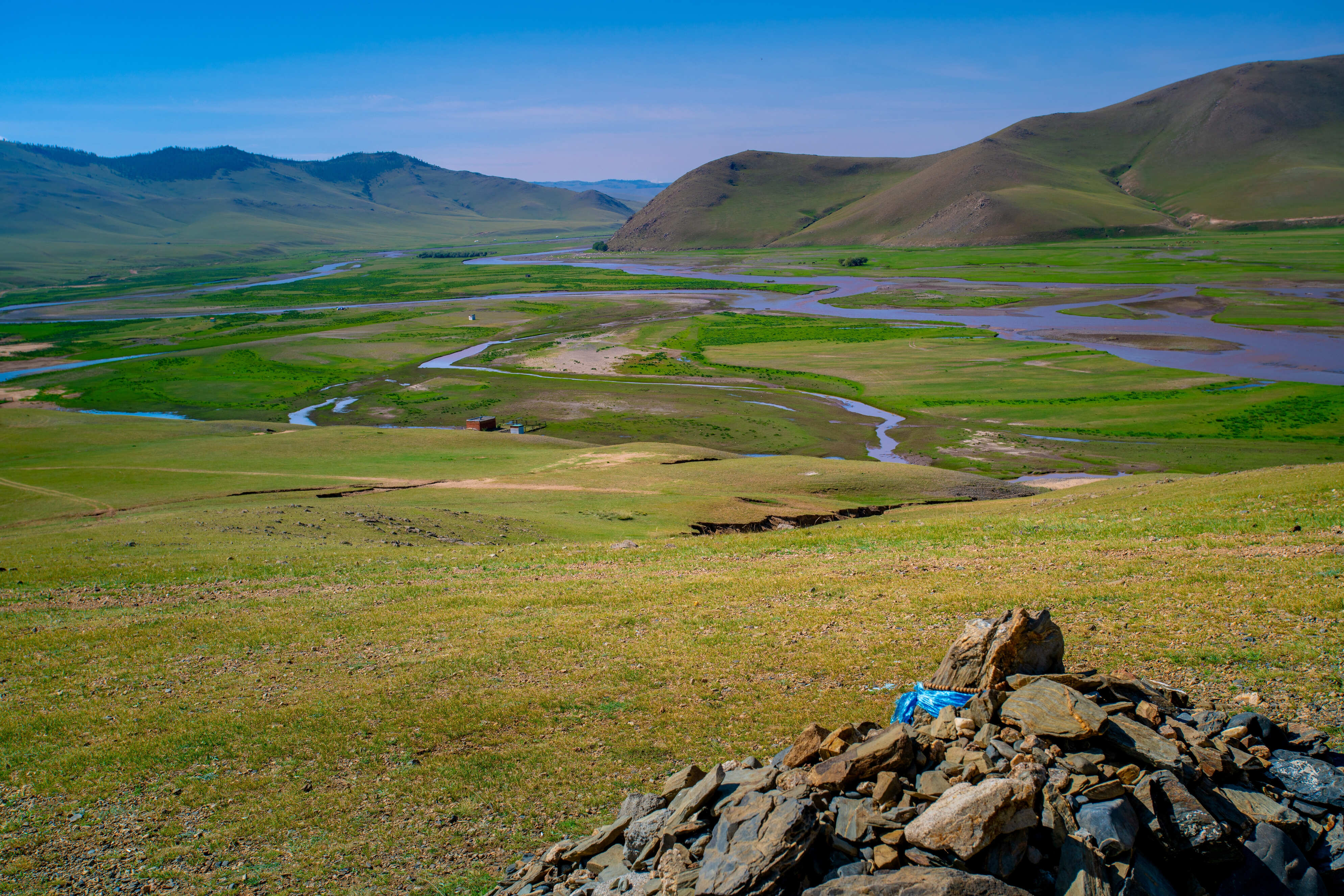
The Gobi spans nearly 1.3 million km² between Mongolia and China, with roughly 500,000 km² on the Mongolian side, scattered across the provinces of Ömnögovi, Dornogovi, Dundgovi and Govi-Altaï. Contrary to popular perception, sand covers only 3 to 5% of the surface: the bulk is a dry, rocky steppe, dotted with weathered rock massifs, canyons and altitude plateaus that peak at 2,800 m in the Gurvan Saikhan range. It is this diversity of terrain, not uniform dunes, that shapes any journey through the region.
The natural entry point is Dalanzadgad, capital of Ömnögovi, connected to Ulaanbaatar by a 1 hour 15 minute flight or 540 km of paved road since 2019. From this town of 20,000 inhabitants, you venture out on tracks that are sometimes sandy, sometimes rocky, where speeds rarely exceed 50 km/h. Plan for two days of 4x4 driving to reach Khongoryn Els, a 180 km-long dune ridge rising to 300 m, locally called Duut Mankhan, the singing sands, for the rumbling caused by sand grains sliding on windy days.
The Bayanzag cliffs, 100 km northwest of Dalanzadgad, are the second major attraction. It was here that in 1923, the American Museum of Natural History expedition led by Roy Chapman Andrews unearthed the first known fossil dinosaur eggs, attributed to Protoceratops. Excavations continue today in the Nemegt and Tugrugiin Shiree sectors, and bones still surface at the base of the reddish cliffs. Further east, the Yolyn Am canyon, within Gurvan Saikhan National Park, harbours a residual glacier that persists until July in some years: you walk between 200-metre walls in 4 to 5 °C while it reaches 35 °C just 30 km away.
The Gobi is inhabited, and this sets it apart from most deserts. Approximately 160,000 people live in Ömnögovi, the vast majority nomadic herders whose livestock blend cashmere goats, sheep, Bactrian camels and horses. The cashmere goat is the central resource here: Mongolia produces roughly 40% of the world's raw cashmere, and a significant share comes from the Gobi. The combing of the down, in April-May, is one of the highlights of families' calendars, something you can join if travelling in spring. Meals under the ger revolve around tsuivan, stir-fried noodles with mutton, khuushuur, a flat fried pastry, and suutei tsai, salted tea with milk.
Wildlife-wise, the Gobi remains one of the few territories where the wild Bactrian camel persists—roughly 800 individuals in the strictly protected Great Gobi A zone—the snow leopard in the Gurvan Saikhan, the Gobi bear or mazaalai, of which only about thirty individuals remain, and large herds of black-tailed gazelles. You won't encounter these animals by chance: you need to plan with a naturalist guide and accept long tracking days. For most travellers, the most accessible encounter is with the domestic Bactrian camel, ridden at dusk in the dunes for 1 to 2 hours.
The Gobi demands commitment: long distances, modest comfort in ger camps, hot days and cold nights. But it is precisely this geographical and thermal range, combined with still-active pastoral life, that makes the region singular compared to the rest of the country.
Highlights
Khongoryn Els dunes at dusk. A trek to the dune crest around 7pm in summer, when the sand has cooled. Views across 100 km of dune ridge to the south, and the green steppe to the north, crossed by the Khongor River where camels drink.
Bayanzag cliffs and palaeontology. A one-hour walk along the Flaming Cliffs, so named by Roy Chapman Andrews in 1922. The ground still contains fragments of fossilized bone visible to the naked eye—do not take them: Mongolian law strictly forbids it.
Yolyn Am icy canyon. A 2 to 3-hour trek through an 8 km gorge where ice persists until July. The small museum at the entrance presents the species of Gurvan Saikhan park, including the Siberian ibex often visible on the slopes.
A night with cashmere herders. A 2-night stay in a family from Bulgan or Bayandalai sum, participating in the gathering of herds at sunset and goat milking at sunrise. In April-May, hand-combing of cashmere down.
Yolyn Am Vulture Valley. Above the canyon, observation from a fixed point of cinereous vultures and bearded vultures nesting in the limestone walls. Regular presence between May and September, binoculars essential.
When to Visit
The practicable season runs from mid-May to end September. June and September are, in our view, the best months: daytime temperatures between 22 and 28 °C, nights around 8 to 12 °C, moderate winds. July-August are the hottest, with peaks of 38-40 °C midday in low-lying areas like Bayanzag, and rare but violent sand storms. Rainfall remains low, 100 to 130 mm per year, concentrated in July, disrupting tracks only occasionally.
From late September, nights fall below 0 °C at altitude in the Gurvan Saikhan, and tourist ger camps close progressively between 10 and 25 October. From November to April, temperatures plummet to -25 °C, some tracks become impassable and only specific expeditions—snow leopard photography or winter herder encounters—justify the journey. Tsagaan Sar, the lunar new year in February, can be an opportunity for a family stay, but demands real cold tolerance.
Practical Advice
We recommend a minimum of 6 days on the ground to do the region justice: 1 day transfer to Dalanzadgad (flight or road), 2 days around Gurvan Saikhan and Yolyn Am, 2 days for Khongoryn Els with a night in a family camp, 1 day for Bayanzag before returning. In 4 days, you're limited to Gurvan Saikhan and Bayanzag, without reaching the great dunes. For travellers seeking palaeontology or remote zones like Nemegt and Khermen Tsav, allow 9 to 10 days.
The most logical combination from Ulaanbaatar is Gobi then Orkhon Valley, heading north via the central track through Arvaikheer, avoiding a return trip to the capital. For a 3-week itinerary, link Gobi, Orkhon, Khövsgöl Lake, then return. Mongolian Altai, further west, requires an additional flight and rarely combines with the Gobi on the same trip except for 25+ days. Comfort remains rustic: tourist gers with beds and wood stoves, shared sanitation, limited solar electricity. The region suits contemplatives, photographers and families with children aged 8-10 and up, provided you accept 4 to 6 hours of daily track driving.