Mongolia's Iconic Animals
Mongolia is home to many fascinating animals! Like the country itself, they are wild, rugged, and utterly remarkable! Horseback Mongolia presents a selection of the most interesting mammals of the country.
Mongolia is home to many fascinating animals! Like the country itself, they are wild, rugged, and utterly remarkable! Horseback Mongolia presents a selection of the most interesting mammals of the country.
Of course, not all could make it into our top 10, and we'll be back soon with other articles on the subject!
The Mongolian Wolf
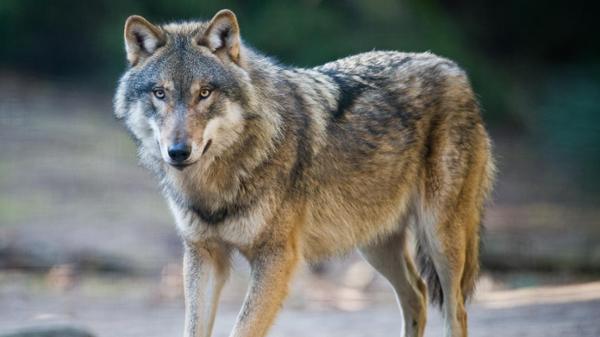
The Mongolian wolf, or Canis lupus chanco, is an animal both respected and feared in Mongolia. The Mongolian wolf is a subspecies of the wolf Canis Lupus, among 32 existing ones. It measures on average 70 cm at the shoulder, weighing between 40 and 50 kg. The largest ever recorded weighed nearly 100 kg and measured 2 meters in total length!
Mongolia represents the second country in the world to harbor the largest wolf population, with over 30,000 individuals. This is not a threatened population. An animal with fascinating and very social behavior, it lives like its European and American cousins in packs. A strict social hierarchy is always respected among wolves, with a dominant pair and many offspring. The family unit can number up to 30 individuals in Mongolia. Wolves are said to be extremely faithful animals, with couples bonded for life. Its tawny coat provides it excellent camouflage in its environment, in the steppes of Mongolia, the desert zones of the Gobi, and further north at the edges of the Taiga forests, near the Russian border, and the Altai mountains. Its territory is vast, as it is an enduring animal capable of covering great distances. It is a carnivore that feeds on any animal it can catch, ranging from the smallest mammals to those larger than itself (sizes from small rodents to gazelles, including sheep and ibex).
It is a symbol for the entire country, as legend says the great conqueror Genghis Khan himself descended from a blue wolf (Börte Chino, representing the sky) and a doe (the earth). It is thus regarded as a memory of the ancestors and is traditionally celebrated. It also symbolizes nature. Along with the horse, it is one of the animals most present in Mongolian history. In Mongolian shamanism, the wolf is a conduit between the God Tengri (of the Cosmos), men, and animals. It is said to help transport the souls of the deceased to Tengri.
Like all wolves, it is a difficult animal to observe or approach, as it is very cautious and shy contrary to what one might think. This reinforces its mysterious side. The wolf is today feared and respected for several reasons. First, livestock herders have mixed feelings toward the canine, as it plays two roles: that of predator feeding on livestock, but also that of guarantor of herd health (the wolf is an opportunistic animal and generally attacks sick or wounded animals, weaker targets and thus easier for pack hunting). It is thus a "doctor" of the steppe ecosystem. In Mongolia, wolf hunting is permitted by authorities in February and May, and holds great significance for the Mongolian population. In the country, the wolf is also a symbol of luck. For a Mongolian, being able to see a wolf and hunt one at least once is considered good fortune for an entire lifetime.
The Manul or Pallas's Cat
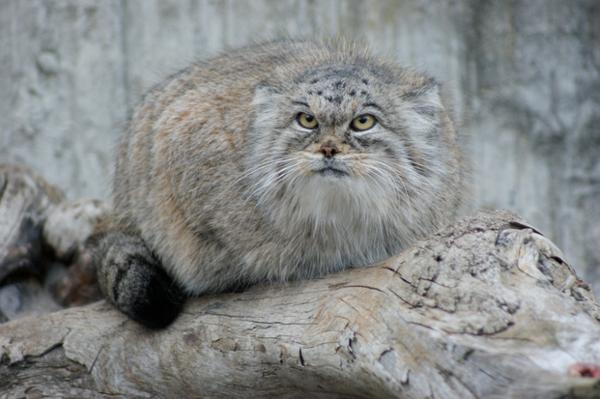
The Manul, or Pallas's cat, is a large wild cat found in Central Asia. This thick-haired feline has its own genus: Otocolobus. It distinguishes itself from other felines by a notable feature: round pupils. This gives it an almost human character, with a range of facial expressions, making it a truly remarkable animal. Barely larger than a domestic cat, it can weigh up to 5 kg. With small paws, ears close to the head and short, and extraordinarily thick fur (as if it were wearing a coat), this big kitty is well adapted to the harsh terrain where it lives. Furthermore, its coat changes color with the seasons (from gray-white in winter to gray-orange in spring), allowing it to blend in, adopting a color close to the rocks where it shelters.
It is found in Russia, China, Iran, Tibet, Kazakhstan, and Mongolia in rocky steppe and desert terrain. Snow does not frighten it, and it withstands negative temperatures down to -40 degrees Celsius! Pallas's cat is, like most felines, polygamous, meaning it can mate with different females during the December to March period. Females can give birth to up to 9 kittens, however infant mortality is high due to a deficient immune system. Only about one-third of kittens reach adulthood.
Cute as it may be, it remains a wild cat, and therefore it is impossible to tame. Moreover, its solitary nature prevents it from being approached. A carnivorous predator, it feeds on rodents, including pikas, ground squirrels, bats, some insects, and small birds. It uses abandoned rodent and marmot burrows as habitat, and blends perfectly into its natural surroundings, among rocks and caves.
Unfortunately hunted for its fur, it remains threatened due to the scarcity of certain prey species, poisoned in some countries like Russia. Additionally, its habitat is shrinking with urban development, and human pollution is driving the species toward extinction. Though it is a protected animal, listed as endangered, the trade in its fur is regulated, and hunting it has become illegal in Mongolia and some other countries. However, the law cannot be enforced everywhere due to funding constraints.
The Takhi (Przewalski's Horse)
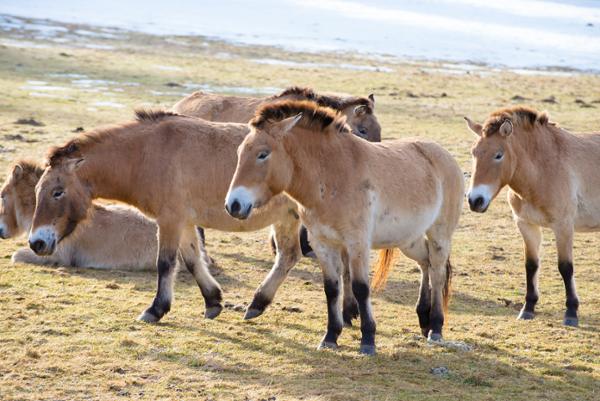
If there is an iconic animal of Mongolia, the Takhi would certainly be it. It is the last true wild horse still in existence in the world. Truly different from the domestic horse we know, it was first described by a Polish naturalist named Przewalski in 1881. So majestic in its natural habitat, it was reintroduced following its extinction in the 1960s caused by numerous hunts organized notably by the Russians during that period. It is currently found in two places in the country, at the Khustai National Park and nature reserve, and in the protected zone B of the Gobi, in southwestern Mongolia. Who better than our Horseback Mongolia, with such a name, could present this distinctive animal that can be encountered on some of our trips? Here is a more complete article on the Takhi, which we published earlier: https://www.voyage-mongolie.com/guide-mongolie/activite/chevaux-sauvages-przewalski/ .
The Long-tailed Ground Squirrel
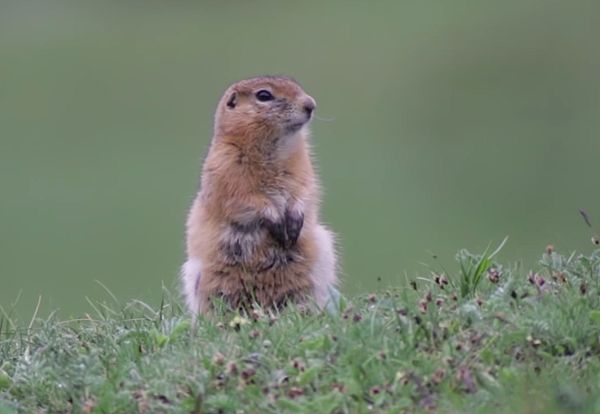
A small ground-dwelling rodent, a type of small sand squirrels, the long-tailed ground squirrel bears a strong resemblance to a marmot, and like it, lives in burrows. It should not be confused with a common European squirrel that lives in trees. It is found in northern Mongolia, in the provinces of Khangai, Khövsgöl, and the mountainous region of Khentii, and in the southwestern part of the country in the Altai-Gobi region. It thus occupies completely different terrains, with a population that can vary from a group of 250 individuals per km² in some areas (wide plains and steppes) to just 1 or 2 individuals per km² in mountainous zones.
It is a diurnal mammal, but most active at dusk. It feeds on grass and cereals, as well as insects. Like the marmot, it is an animal that hibernates during the October to mid-April period, and stores food in advance for this entire duration. A female can give birth to up to 9 young, 30 days after mating. The breeding period lasts during spring. The animal is not currently threatened, following a decline in hunting for its fur. Fifty years ago, approximately half a million individuals were hunted almost every year.
The Snow Leopard
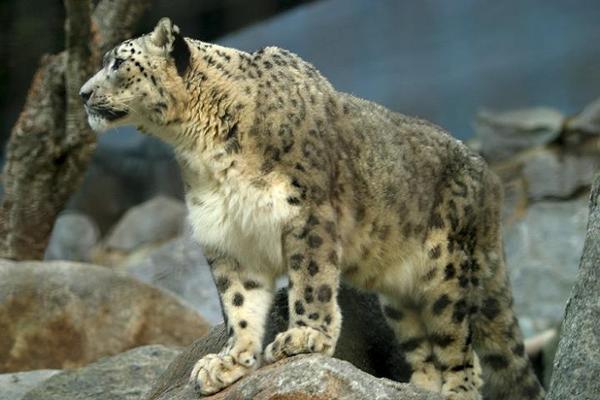
A legendary and mysterious animal, the snow leopard is also called the snow panther. It is very rare to observe in the regions of Altai and Khangai, on the peaks of high mountains. In Mongolia, it is the largest feline, measuring approximately 1.30 meters, and weighing between 35 to 55 kg. An excellent climber, it perches on heights, rocks, and mountain slopes with remarkable ease, aided by its long tail which helps it maintain balance. It is an animal still little known, as few encounters and research have been conducted about it.
It is said that the species is in decline in Mongolia, caused by poaching and the decreasing number of prey in its territory. It feeds essentially on wild sheep, ibex, and other ungulates living at high altitudes. It is an animal that is opportunistic and a skilled hunter, not hesitating to attack other mammals such as deer, marmots, hares, or wild boar when descending from the mountain. It even comes into conflict with goat and sheep herders in the country. It is an essentially diurnal hunter, but like panthers, it can see and hunt at night. An excellent jumper, its musculature allows it to leap from rock to rock on steep slopes, and it can make jumps of nearly 6 meters high and a maximum length of 15 meters! Its athletic form brings it closer to the cheetah than the panther, with strong and long hind legs allowing these extraordinary jumps. Its coat is very thick and long, renewed twice a year. Its characteristic pale gray or cream coloring, with a completely white belly and spots on the back, allows it to blend with its environment. It is thus very well adapted to its environment, with the ability to remain at very high altitudes, between 2,000 and 6,000 meters. The snow leopard is a solitary creature, and covers a very vast territory (it is said that a pair of snow leopards covers an area the size of a valley). It only reproduces from January to March, and can have up to 5 young per litter. Young are born after 3 months of gestation, blind for a week. They will separate from their mother after 7 months.
The population of snow leopards is the second largest in the world in Mongolia after China. It is estimated between 500 and 1,000 individuals in Mongolia, over an area of 101,000 km². The main threats to this feline are poaching, reprisals following loss of livestock by herders, loss of habitat or reduction in the number of prey due to human activity (including mining activities in southern Mongolia).
The Argali Sheep
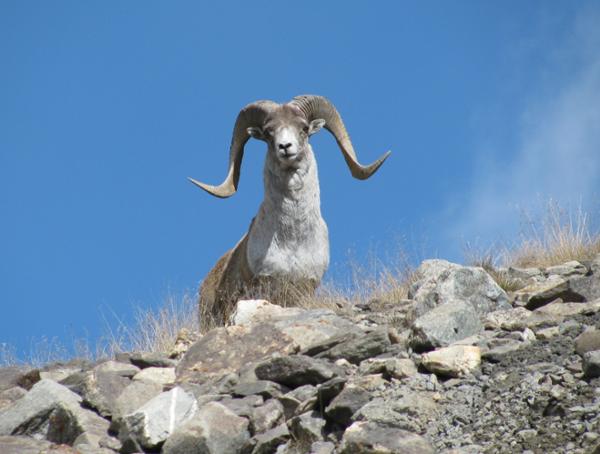
The argali is the largest wild sheep in existence. This ovine lives in Central Asia, China, the Himalayas, and Mongolia. Its size varies between 1.4 and 1.6 meters at the shoulder, and weighs up to 120 kg. It is distinguished by its tawny light or dark brown-gray colored coat. Both females and males have horns, with the males having the longest, reaching up to 1.25 meters long with a circumference of 50 cm. The points are directed outward. These horns alone can weigh 22 kg! Males and females differ also in their coat; males have a white collar around the neck and a crest along the back. They are broader than females. Their coat is renewed once a year, with a light coat and thicker hair for winter and a darker one in summer.
The argali sheep is a high mountain animal and its habitat is generally situated between 1,300 and 6,000 meters above sea level. It feeds on seeds and grass, like all herbivorous ruminants, in an environment often without trees, and interestingly: males often remain lower, where the grass is richer and more abundant. They remain in herds apart from females throughout the year, except during breeding season, in autumn and early winter. They fight then among themselves, clashing their magnificent horns to gain access to available females. A lamb takes 6 months to be born and is nidifugous, meaning totally autonomous for a few days, then requires its mother's help. An argali lives on average 10 to 13 years and males are the most durable.
The main threats to the argali are hunting (mainly for its large horns), the advancement of livestock on its territory, and carnivorous predators such as the wolf and the snow leopard. Efforts have been made to protect the argali in Mongolia, including the Ikh Nart reserve in Dornogovi province, about 600 km southwest of Ulaanbaatar. Around 600 argali sheep are estimated in this space. Moreover, a monument was erected in Ulaanbaatar to commemorate this imposing animal, just across from the natural history museum of the capital. A proud massive bronze statue in the likeness of the sheep.
The Saiga (Saiga tatarica Mongolica)
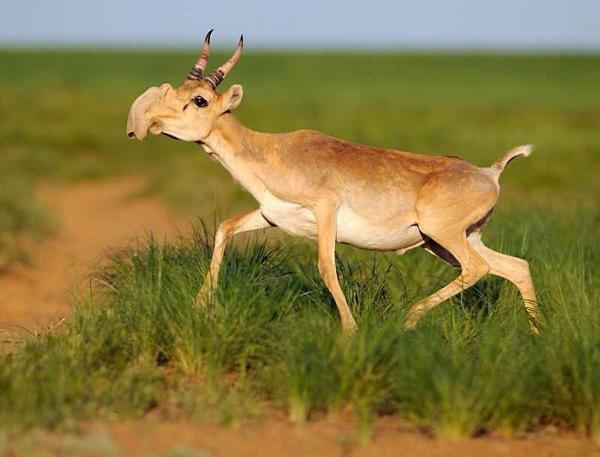
The Saiga is the only Eurasian antelope in existence. Its origins are somewhat unclear, but it is thought to have evolved in vast treeless expanses and on hills, over a very large territory between Europe and Asia. It is a mammal threatened with extinction. With a snout that resembles a trunk characteristic, which distinguishes it from other antelopes, the Saiga (a Russian name meaning "antelope") is a truly particular animal. It is not very large, measuring 1 meter to 1.45 meters, weighing between 21 to 50 kg. The Eurasian antelope has a coat that changes with the seasons, going from light blonde-reddish during warm seasons to white in winter. Beautiful ringed horns of a maximum of 30 cm adorn only the males. It is even possible to determine their age through the size of their horns, for example 7 to 10 cm for 1 year, and the S-shaped curve appears from age 2 onward.
It is a very fast animal, like the African cheetah, it can accelerate to speeds of nearly 100 km/h over short distances, which protects it from multiple predators. Very enduring, it can run several kilometers at nearly 40 km/h. This herbivore appeared during the last glacial period, and lived over a large territory, from Central Asia, Europe, and even North America. Today, this animal is found in Central Asian plains, Russia, Kazakhstan, and Mongolia.
In Mongolia there is a subspecies of Saiga, Saiga tatarica Mongolica, recognized as such and numbering approximately 3,000 individuals, in Gobi-Altai Province, in the western part of the country, in the preserved basin of Altai-Sayan and that of the great lakes of Khovd Province.
The Saiga is a fragile animal, reproducing only over a 2-week period per year. It lives under the constant threat of humans and competition from livestock for the territories it occupies, poaching, and severe Mongolian climatic conditions (the winters of the 2000s decimated a large part of the population).
This herbivore has precarious health, the result of genes sensitive to disease, and very recently in 2015, a die-off of the Saiga population in Kazakhstan proved dramatic, with nearly 200,000 animals found dead in May. It is supposed that climate played an important role in this catastrophe, with a relatively hard winter, causing fragility of the animal's immune system, and after a sudden temperature change and abundant rain, the animals fed on grass in damp soil bringing bacteria. Thus the Eurasian saiga, facing numerous threats, remains protected, and increasingly sustained efforts by the Mongolian government and other concerned countries tend to discourage poaching.
The Khulan (Equus hemionus)
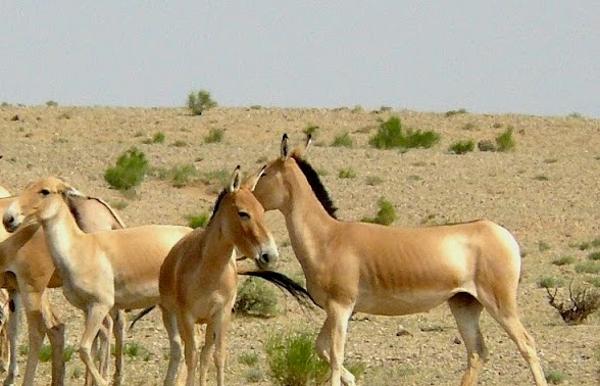
Photo credit: Anne-Camille Souris, for the Goviin Khulan Association
The Khulan (Хулан in Mongolian), is one of 5 subspecies of the wild Hemione of Asia. It belongs to the family of equids, which groups the domestic horse, Przewalski's horse, the zebra, and all domestic and wild donkeys of Africa and Tibet (the Kiang). It is found essentially in Mongolia in the Gobi desert, and in northern China. Previously part of the Khulan population also existed in Kazakhstan and Russia, in southern Siberia. These have been exterminated by hunting campaigns. The Khulan population in Mongolia is estimated at around 14,000 individuals, figures to be taken with a grain of salt, as very few studies have been conducted for census. An herbivore animal, the Khulan feeds on grass and local vegetation such as small bushes in the areas found on its territory. In the Gobi desert, the Khulan is an animal particularly well adapted to arid conditions, and can during the dry periods of summer dig into the soil itself to find shallow water sources, in dried-up river beds. It is a useful animal for the survival of other species, since other mammals subsequently use these holes for their own needs. They became very quickly indispensable even for humans in the Gobi desert, following the abandonment in the 1990s of many wells dug during the communist period that marked water points in the region. The main threats to the Khulan are poaching and livestock herding activity. Livestock competes with the Khulan for precious resources such as water and pasture. Major road and rail corridors (notably Ulaanbaatar-Beijing) contribute to bringing livestock and animals closer together, and promote these problems. They are also victims of predator attacks such as wolves, but can escape fairly easily, thanks to a running speed of nearly 65 kilometers per hour.
The Bactrian Camel
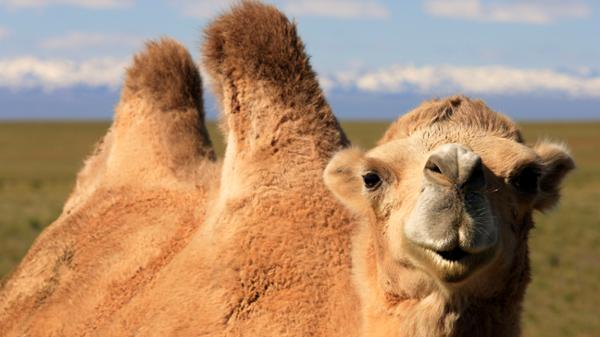
The Bactrian camel is a species endemic to the steppes of Central Asia. It distinguishes itself from the dromedary by its two humps. It is commonly found in Mongolia and northwestern China. Its name of Bactrian refers to the first writings on the domestication of this animal, from the Province of Bactria under the Persian Empire (between the 3rd and 2nd centuries B.C., located between Afghanistan, Tajikistan, and Uzbekistan). It is thought that its first domestication dates back to nearly 4,000 years ago.
It is used for its many qualities. The animal being very sturdy, at a height of nearly 2 meters (counting the humps), it serves as a pack animal for desert travels. It gives milk, its fur is used to make many clothes, duvets and ropes, and its excrement is very important to herders of arid regions (used as fuel throughout the region). Its meat is also a precious resource. In areas where water resources are scarce, it is perfectly adapted thanks to its two humps, serving as reservoirs. It is quite remarkable to observe that it can drink up to one hundred liters of water at once! It has very thick and hard skin to protect itself effectively from heat, and a system that allows it to protect itself from sandstorms, thanks to 2 rows of eyelashes covering its eyes. Cold also does not frighten it, as its fur acts as a thermal barrier. It is an animal that feeds on plants, grass, small bushes, seeds, and leaves.
There are approximately 1,000 wild camels living in the Gobi desert, with other populations in other countries such as Iran, Afghanistan, Turkey, and Russia. The border zone with China is the ideal place for the Bactrian camel to inhabit, and it rightfully represents the icon of the Gobi desert, for its rustic and extreme character. More and more events are being organized to celebrate it, such as the Festival of 1,000 Camels between March 6 and 7 each year, in Ömnögovi province.
The Mazaalai (the Gobi Bear)
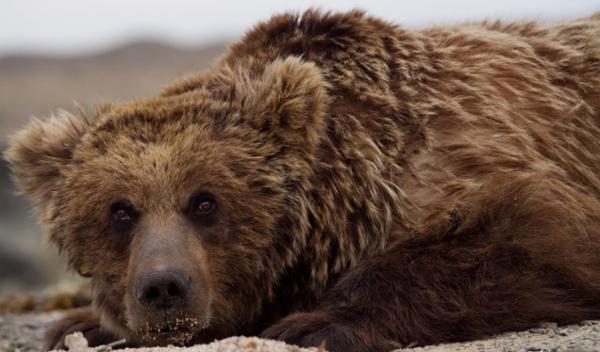
A rare and mysterious animal, the Mazaalai or Mongolia's long-haired bear is one of the most threatened animals in the country. It is the rarest bear on the planet. With more than just a few dozen individuals currently alive in the Gobi desert, the Mazaalai population is shrinking more and more due to changing climatic conditions, lack of food and water. Like many wild animals, it competes with livestock for increasingly appropriated lands by herders in the region. Traps or accidents are possible, making their living conditions even more difficult. Bears live solitary lives and are exposed to fights between themselves if they meet on the same territory. It is an animal that lives in protected areas of the Gobi, on heights, and among rocks. With a long coat compared to brown bears, its amber color resembles more the American grizzlies. It is a large mammal that can reach sizes of 150 cm and a maximum weight of 138 kg.
It is made for Mongolia's harsh climate, with thicker fur and a build to withstand the extreme temperature differences existing in the region (very hot during the day, very cold during the night). Like its American and European cousins, it feeds on berries, rhubarb roots, and small rodents, and hibernates during the winter period. The Mongolian government launched an awareness and species protection campaign in 2013, the Year of the Mazaalai, and even refused mining permits to preserve its already restricted territory.
To further illustrate this article, here is a short video from National Geographic's Facebook page for Mongolia. Beautiful images and rare moments of observation of these wild animals! Have you noticed that no birds appear in this top 10 of Mongolia's iconic animals? That's because we're preparing another article on this subject, dealing with the golden eagle and other colorful birds for the pleasure of the eyes. While there are certainly other iconic animals, describing them all would only make this article too heavy for you. Mongolia is a fascinating territory with truly unique fauna and flora, which is interesting to really discover by taking the time, at any time of the year (even if in winter, I'll admit, it's a bit cold!). Hoping to have thrilled you as much as we are about these furry creatures on four legs that so well represent the diversity and wild side of Mongolia, we'll be back soon with other beauties!