Unknown Facts About the Gobi Desert
Stretching between Mongolia and northern China, the Gobi Desert is the preferred destination for travelers seeking freedom and wide-open spaces. While this expanse of sand is known for its beauty that showcases nature's wonders, it also holds countless fascinating facts that remain little-known to this day.
Stretching between Mongolia and northern China, the Gobi Desert is the preferred destination for travelers seeking freedom and wide-open spaces. While this expanse of sand is known for its beauty that showcases nature's wonders, it also holds countless fascinating facts that remain little-known to this day.
To help change that, Horseback Mongolie has compiled a few of them:
Gobi is not a Mongolian name
Contrary to what one might think, the word "Gobi" is not a Mongolian name! In fact, it comes from the Chinese name "Gebì," which means "desert," for the simple reason that it is shared between Mongolia and China. Moreover, if you look closely at a map, you'll notice that the vast majority of the desert belongs to China. It is located in the autonomous region of Inner Mongolie, which is the third-largest province of China (not to be confused with the country itself!).
The largest desert in Asia
With an estimated area of 1,300,000 km2, the Gobi Desert represents the largest in all of Asia. As for the ranking of the world's largest deserts, it ranks 5th after Antarctica, the Arctic, the Sahara, and the Arabian Desert.
The coldest desert in the world
Many are unaware that Gobi also has the reputation of being the coldest desert in the world. During winter, temperatures can drop to -40°C! It also holds the record for the greatest temperature variation, given that the temperature difference between the two seasons, summer and winter, can reach 90°C!
Sand, but not just sand!
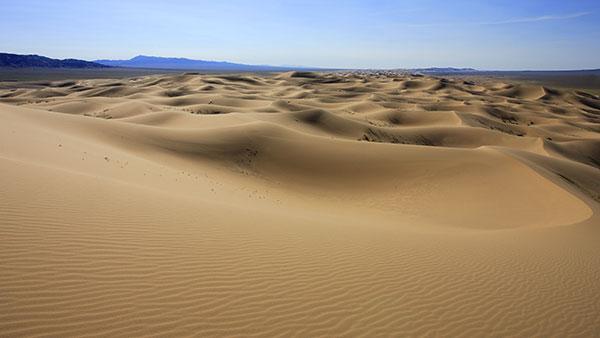
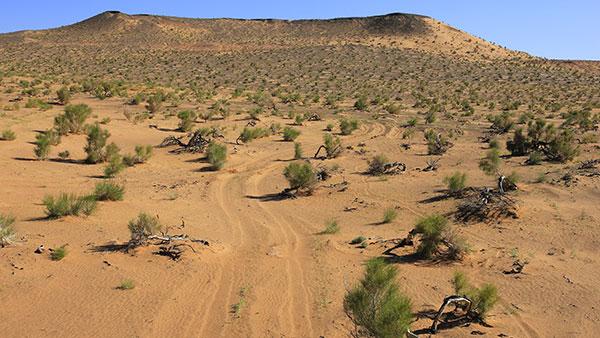
When we speak of a desert, we tend to imagine a vast expanse of sand. But what makes the Gobi Desert unique is that only 5% of its area is made up of sand. It's worth noting that these 5% include the two famous dunes: Khongor-els in the south and Mongol-els in the west.
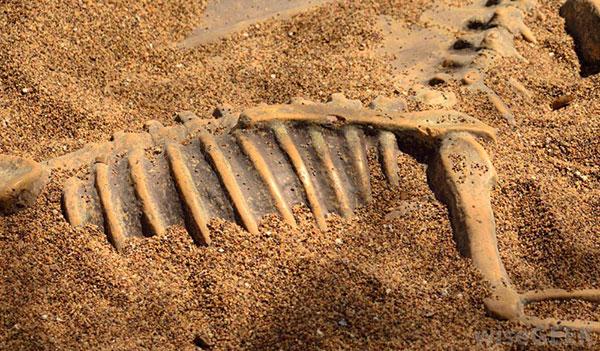
A paleontologist's paradise
On August 21, 2016, a team of Japanese scientists from Okayama University, in collaboration with the Institute of Paleontology and Geology of the Mongolian Academy of Sciences, revealed the existence of one of the largest dinosaur footprints ever discovered to date. This imprint was found in a geological layer dating from the upper Cretaceous period, between 70 and 90 million years ago!
Have you ever set foot in this mythical desert? Feel free to share your anecdotes in the comments!
If you haven't yet discovered Gobi, let yourself be tempted by our journey Between Steppe and Desert, which will allow you to visit this legendary desert as well as the steppes and mountains of central Mongolie.