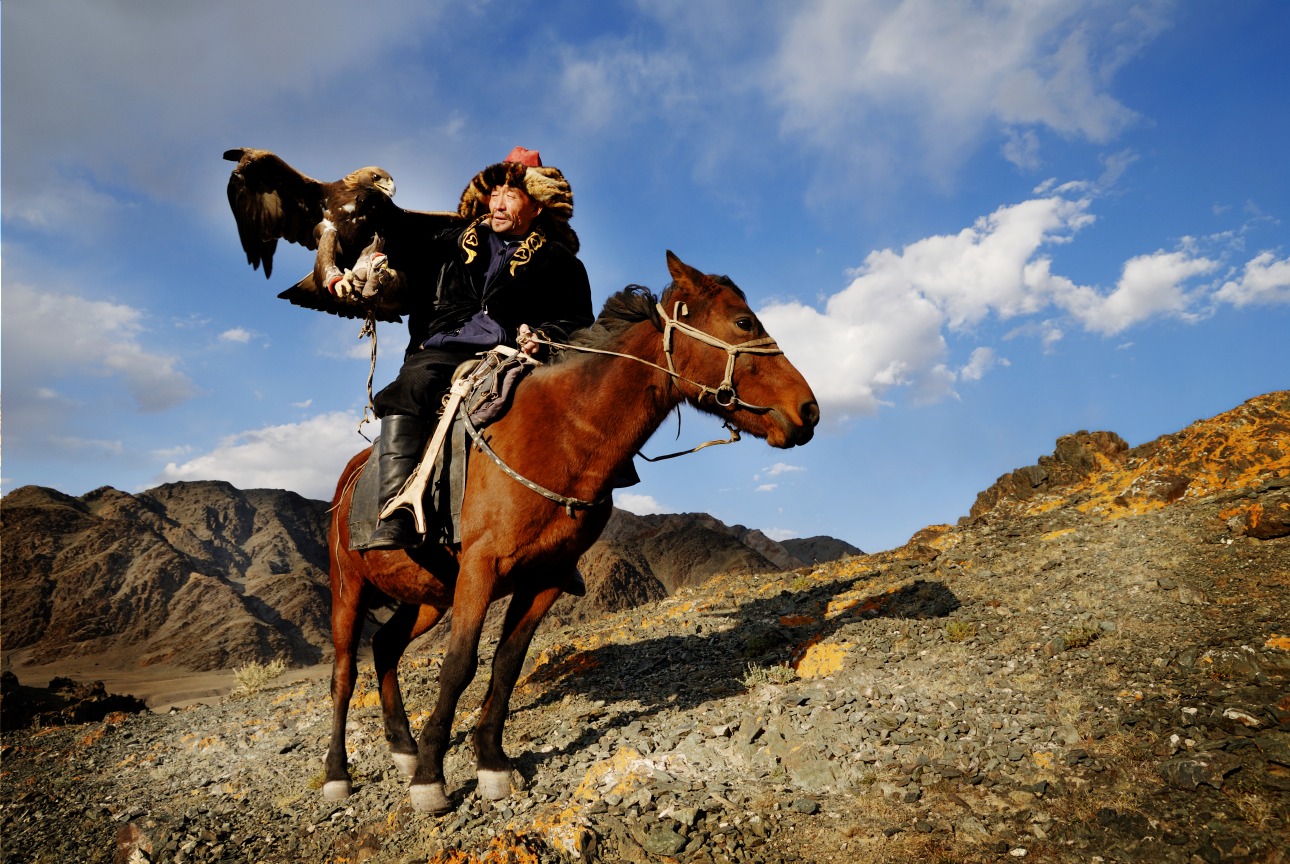
The Naadam Festival
The Naadam Festival
The Naadam, meaning "game" in Mongolian, is Mongolia's largest traditional event. The games are held from July 11 to 13 to celebrate the anniversary of the 1921 Mongolian revolution. The Naadam is
The Naadam, meaning "game" in Mongolian, is Mongolia's largest traditional event. The games are held from July 11 to 13 to celebrate the anniversary of the 1921 Mongolian revolution. The Naadam is also known locally as "Eriin Gurvan Naadam", "the three manly sports", referring to the three major competitions held on this occasion: Mongolian wrestling, horse racing and archery. Women can now participate in archery competitions, and young girls in horse races. Wrestling competitions remain exclusively male.
Another popular activity is bone throwing, a game using sheep bones known as shagaï, which serve both as game pieces and divination tokens.
In 2010, the Naadam was inscribed on the UNESCO Representative List of the Intangible Cultural Heritage of Humanity.
The Naadam in Ulaanbaatar
While Naadams are held across the entire country, the largest festival is organized in the Mongolian capital, Ulaanbaatar during the national holiday from July 11 to 13.
The first day of the Naadam begins at 9:00 AM with a colorful ceremony held at Genghis Khan Square. Hundreds of soldiers in traditional military uniforms play war music on brass instruments. They parade around the square, then circle the parliament building before marching to the stadium where the opening ceremony takes place.
The opening ceremony traditionally begins at 11:00 AM. It is a grand spectacle typically featuring a parade of soldiers, monks and athletes. A traditional show follows, with dancers, musicians and singers. The president delivers a speech and wishes all the Mongolian people a good Naadam.
Next, within the stadium over two days, wrestling competitions will be held. In the stadium stands, you can watch archery competitions as well as bone throwing contests.
What is probably most interesting for travelers is the atmosphere around the stadium: Mongols, dressed in their finest for the occasion, come to savor the culinary specialty of the Naadam: khuushuur! A Naadam would not be complete for a Mongol without tasting these delicious fried meat pastries. While relatively few people can attend the competitions inside the stadium itself, many come to eat at the numerous stalls surrounding it, and of course to drink a bowl of airag, fermented mare's milk.
For horse racing, you will need to go to the Khui doloon khudag site, 50 km from central Ulaanbaatar. Don't try to do everything in one day, but dedicate the first day to the stadium and the second to the racetrack. There are large crowds at the horse arrivals and it's quite chaotic. Don't expect to take good photos, but rather to experience the popular fervor surrounding the races.
Very few seats are available in the stands near the finish line: approximately 400 seats for over 10,000 requests, and they are in fact reserved for Mongolian elites and wealthy foreigners. Don't expect to find a seat, but rather to battle to get as close to the horses as possible!
On the second day, around 7:00 PM (though this actually depends on when the wrestling competitions end), the closing ceremony takes place.
The Naadam in the Provinces
Many travelers prefer to attend rural Naadams, which are generally held a few days before the grand Naadam in Ulaanbaatar. The schedule of provincial Naadams changes every year and is only known a few weeks before the festivities begin. However, they are generally held on July 10 and 11 in provincial capitals, July 9 and 10 in medium-sized towns (Karakorum for example), and between July 6 and 9 for the smallest villages. Moreover, since games can be organized on many occasions (a village anniversary for example), it is not uncommon to come across Naadams throughout the summer season. While the quality and number of sporting events offered are certainly less than in the capital, you will have more proximity to the athletes and above all, the opportunity to experience this event in a friendly atmosphere. You can even enter Mongolian wrestling competitions if you wish.
History
The Naadam is the most popular festival among Mongols and is believed to have existed, in one form or another, for centuries. The Naadam originates in the military activities of ancient times, when being able to ride horses, shoot arrows and wrestle were essential qualities for warriors. Men competed against each other to determine who was the best. These competitions notably served to train soldiers for battle. Later, they were organized for various occasions, such as weddings or other religious gatherings. Today, the Naadam officially commemorates the 1921 revolution and Mongolia's independence, as well as the establishment of a new state. In its early years, the Naadam was organized jointly with minor religious celebrations until secularization in the 1930s.
The three manly sports were then called "danshig" games and were the occasion for a great celebration for the new nation, where all the nobility gathered to celebrate Javzandamba Khutagt, the new head of state.
The nine yak tails of Genghis Khan, representing the nine Mongolian tribes, are still solemnly transported from Genghis Khan Square to the Stadium at the opening of the Naadam festivities.
Mongolian Wrestling
512 or 1024 wrestlers meet in a single-elimination tournament lasting nine or ten rounds. There are no weight categories, which makes the early rounds entertaining for inexperienced spectators. Generally speaking, the larger and heavier the wrestlers, the better their chances of winning. A wrestler is declared the winner if his opponent touches the ground with any part of his body other than his feet or hands. There is no time limit and some bouts can last several hours (which is far less entertaining for the untrained eye). Wrestlers with the most titles already have the privilege of choosing their opponent.
Wrestlers wear a two-piece costume consisting of an open vest tightly fitted on the shoulders, the "zodog", and a mini-shorts, the "shuudag". The ensemble is most often blue or red, but can also be pink or green, and the two pieces can be mismatched. Only men are allowed to compete. The open vest is said to have been introduced after a woman disguised as a man defeated all the wrestlers. With the vest open, women can no longer hide to participate in competitions.
Each wrestler is accompanied by an "encourager" called zasuul. The zasuul sings the praises of the winning wrestler after the 3rd, 5th and 7th rounds.
- Winners of the 5th round receive the title of nachin, falcon.
- Winners of the 6th round receive the title of khartsaga, hawk.
- Winners of the 7th round receive the title of zaan, elephant.
- Winners of the 8th round receive the title of garid, Garuda.
- The final winner is called arslan, lion.
- Wrestlers who have won the title of arslan twice are called avraga, titans, giants.
Horse Racing
Unlike Western horse racing, which consists of pure speed races over short distances, Mongolian races are more like endurance cross-country events, over distances between 10 and 26 km depending on the age of the horses and the season (races organized in spring being shorter than those in summer).
- Two-year-old horses, called daaga, cover between 10 and 12 km.
- Three-year-old horses, called shudlen, cover between 12 and 14 km.
- Four-year-old horses, called khyazaalan, cover between 17 and 18 km.
- Five-year-old horses, called soyolon, cover between 22 and 24 km. This is the most important race.
- Horses over 5 years old, called ikh nas, cover between 25 and 26 km.
- Stallions, azarga, cover between 22 and 24 km.
During the major Naadam races in Ulaanbaatar, there can be up to 1000 horses coming from all Mongolian provinces. Racing horses follow a special diet.
The jockeys are children (boys or girls) aged 5 to 13, who train for months. Although jockeys play an important role, the main objective of the races is to test the skill and endurance of the horses. It is worth noting that some horses sometimes cross the finish line without their rider, and this does not disqualify them in any way.
The races take place across open steppe, so there is no track. This sometimes leads to cheating, with some "spectators" occasionally trying to slow down competing horses. From time to time, some horses exhausted by the race die on the racetrack.
Before the races begin, the public sings traditional songs, while the jockeys sing in honor of Giingo, the God of racehorses, so their horse will be more valiant. Prizes are awarded to horses and jockeys.
- The five leading horses in each category receive the title of airgiin tav; gold, silver and bronze medals reward the top three.
- The winning jockey receives the title of tumnii ekh, meaning "first of the people".
- The horse that finishes last in the race, daaga, is dubbed bayan khodood, "full belly". A song is sung for the bayan khodood to wish it good luck and hope it will be the winner next year.
At the end of each race, spectators rush toward the five winning horses to collect the animal's sweat and rub it on their foreheads as it is believed to bring good luck. The crowd admires the winning horses, who are spoken of with respect. For the winning breeder, their fortune is made, as the price of their horses skyrockets. Traditional poems are recited praising the virtues of the riders and breeders. The five winning riders must also drink a bowl of airag; the drink is then poured over the child jockey's head and on the horse's croup.
Archery
The archery competition is open to both men and women. It is played in teams of 10 archers. Each archer has four arrows and each team must hit the target a minimum of 33 times, "sur". Men shoot their arrows from 75 meters while women shoot from 65 meters. Traditionally, archers wear the national garment, the deel, during the competition. All archers are equipped with a leather armguard that covers their extended arm up to the elbow, so the deel sleeve does not interfere with their aim. The bows used are composed of alternating layers of animal horn, bark and wood. The arrows are generally made of willow wood, with feathers from vultures or other birds of prey.
Mongolian archery is unique in the world because there is not a single target, but dozens. Small woven or wooden cylinders serve as targets. They are stacked on top of each other forming a wall 20 cm high by 1.5 meters wide. Hitting a target on the wall counts as one point, but hitting a target placed in the center scores more. When the archer hits the target, the judge says "uukhai", which means "hurrah", and raises his hands in the air to indicate the quality of the shot. After each shot, the targets must be reinstalled to prepare the wall for the next attempt. Winners of the event receive the honorary title of Mergen, "archer of the nation".
Give it a go!
Our local experts arrange this activity for you.