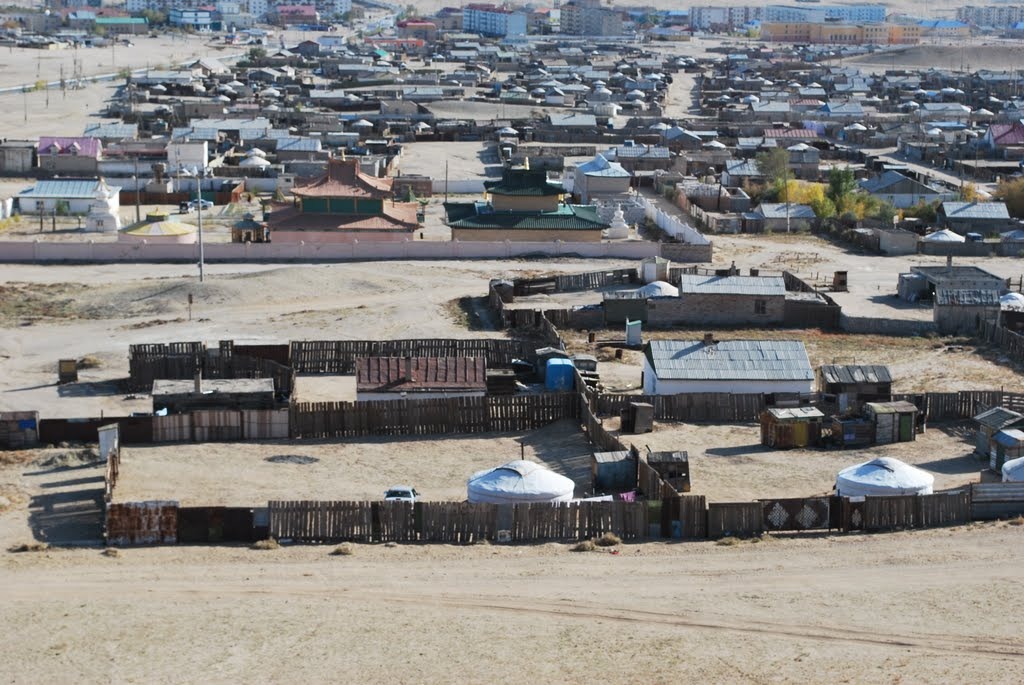
About 45 km south of Sainshand, on the slopes of Sharil Mountain, the Khamarin Khiid — literally "monastery of the buttress" — ranks among the most striking Buddhist sites in the Mongolian Gobi. Founded in 1821 by poet, playwright, and spiritual master Danzanravjaa (1803-1856), it was destroyed during the Stalinist purges of 1938, then partially reconstructed. The place retains today a powerful symbolic dimension, often associated with Mongolian Shambhala.
Why visit Khamar Monastery
- A foundational site of Mongolian learned culture, which housed the country's first public school, first professional theater, and museum.
- The legacy of Danzanravjaa, a major figure in Mongolian literature and Buddhism, classified among the "Red Sect."
- A landscape of steppe and rocky hills dotted with meditation caves, in an atmosphere of living pilgrimage.
- An easy stop from Sainshand, capital of Dornogovi province, accessible via the Trans-Mongolian railway line.
History: Danzanravjaa and the radiance of Khamarin Khiid
Khamarin Khiid was built in 1821 and was one of three monasteries of the third Javzandamba Khutagt, Danzanravjaa, a Mongolian scholar and man of letters. The site was an important center of the Buddhist "Red Sect" and the seat of the Gobiin Dogshin Noyon Khutagt ("Terrible Saint Noble of the Gobi").
A fierce critic of the society of his time, Danzanravjaa fought against rigid class and gender distinctions. He devoted great effort to public education, which he developed at the monastery through the creation of a public school, theater, museum, and library — an ensemble unique in 19th-century Mongolie.
An artistic and intellectual center
The Namtar Duulakh Datsan, established in the 1830s, is considered Mongolie's first professional theater. The Khuukhdiin Datsan ("children's college") trained youth from the region there: many became singers, dancers, painters, or sculptors, attached to the monastery or its troupe.
The most famous work composed here is the play Saran Khokhoo Namtar ("The Library of the Moon Cuckoo"), written by Danzanravjaa in 1830 and performed several times at the monastery during his lifetime. After his death, his servant Tudev saved the text and sacred objects of the monastery; preserved by his descendants, these items resurfaced in 1990.
Peak and destruction
At its height, Khamarin Khiid comprised four main sections — East Khuree, West Khuree, Tsokhon, and Dunkher — with four colleges, more than 80 temples, and over 500 resident lamas. The main temple stood on two levels. In 1938, the monastery was entirely destroyed by the army during the religious purges that struck the entire country. Today, two small ceremonial temples and several religious monuments have been reconstructed, and a small community of lamas resides there.
What to see on the site today
Reconstructed temples
Two modest ceremonial temples, erected since the 1990s, host services and visitors. They offer a glimpse of the liturgy of the "Red Sect" and house paintings, statues, and ritual objects.
Övgön Suvarga, the old man's stupa
Before the monastery stands the Övgön Suvarga stupa, said to contain the relics of Danzanravjaa. It is one of the most important places of reverence for pilgrims.
Meditation caves
North of the site, rocky slopes shelter dozens of small caves. Tradition holds that monks retreated there for cycles of yoga and meditation lasting up to 108 days, to strengthen body and spirit. Several caves remain in use today.
Shambhala and the energy of place
The area is associated, in local tradition, with one of the "gates" of Shambhala, the sacred kingdom of Tibetan Buddhism. Pilgrims come to circumambulate the stupas, leave offerings, and walk in the surrounding steppe, considered particularly charged with spiritual energy.
Practical information
- Visit duration: allow 2 to 3 hours for the monastery, stupas, and a walk toward the caves.
- Entrance fee: modest entry, donations welcome for the monastic community.
- Season: accessible from late April through October; Gobi winters are harsh and windy.
- What to bring: water, sun protection, modest clothing for temples, and sturdy shoes for rocky paths.
- Etiquette: circumambulate stupas clockwise, take photos discreetly inside temples.
How to get there
The monastery is about 45 km south of Sainshand, capital of Dornogovi province. Sainshand is connected to Ulaanbaatar by the Trans-Mongolian train (overnight journey) and by road. From town, the site is reached by four-wheel-drive vehicle in under an hour; the track is decent but without regular public transport. Most travelers include Khamarin Khiid in a Gobi circuit with a driver.
To combine in the region
- Sainshand and its Danzanravjaa museum, which preserves some of the objects saved in 1938.
- The Shambhala energy complex (Shambhala Land), a short distance from the monastery.
- Gandantegchinlen Monastery in Ulaanbaatar, Mongolie's principal active Buddhist center.
- Khambiin Khiid Monastery, another major Gobi spiritual site.
- Gunj Temple, to continue exploring Mongolian religious architecture.
Frequently asked questions
Frequently asked questions
Khamarin Khiid translates to "monastery of the buttress," referring to its position on the slopes of Sharil Mountain.
Danzanravjaa (1803-1856) was the third Javzandamba Khutagt, a Mongolian poet, playwright, and Buddhist master. He founded Khamarin Khiid in 1821 and developed a public school, theater, museum, and library there.
Like most Mongolian monasteries, Khamarin Khiid was razed in 1938 by the army during religious purges orchestrated under Soviet influence. Reconstruction began only after 1990.
Yes. Two ceremonial temples have been reconstructed and a small community of lamas resides there. The site is also a regular pilgrimage destination.
Allow 2 to 3 hours to visit the temples, circumambulate the stupas, and walk to the meditation caves north of the site.
Include Khamar Monastery in your journey
Khamar Monastery naturally fits into a circuit in the eastern Gobi, departing from Sainshand. To build a custom itinerary combining Buddhist heritage, steppes, and desert, explore our Mongolie travel ideas.