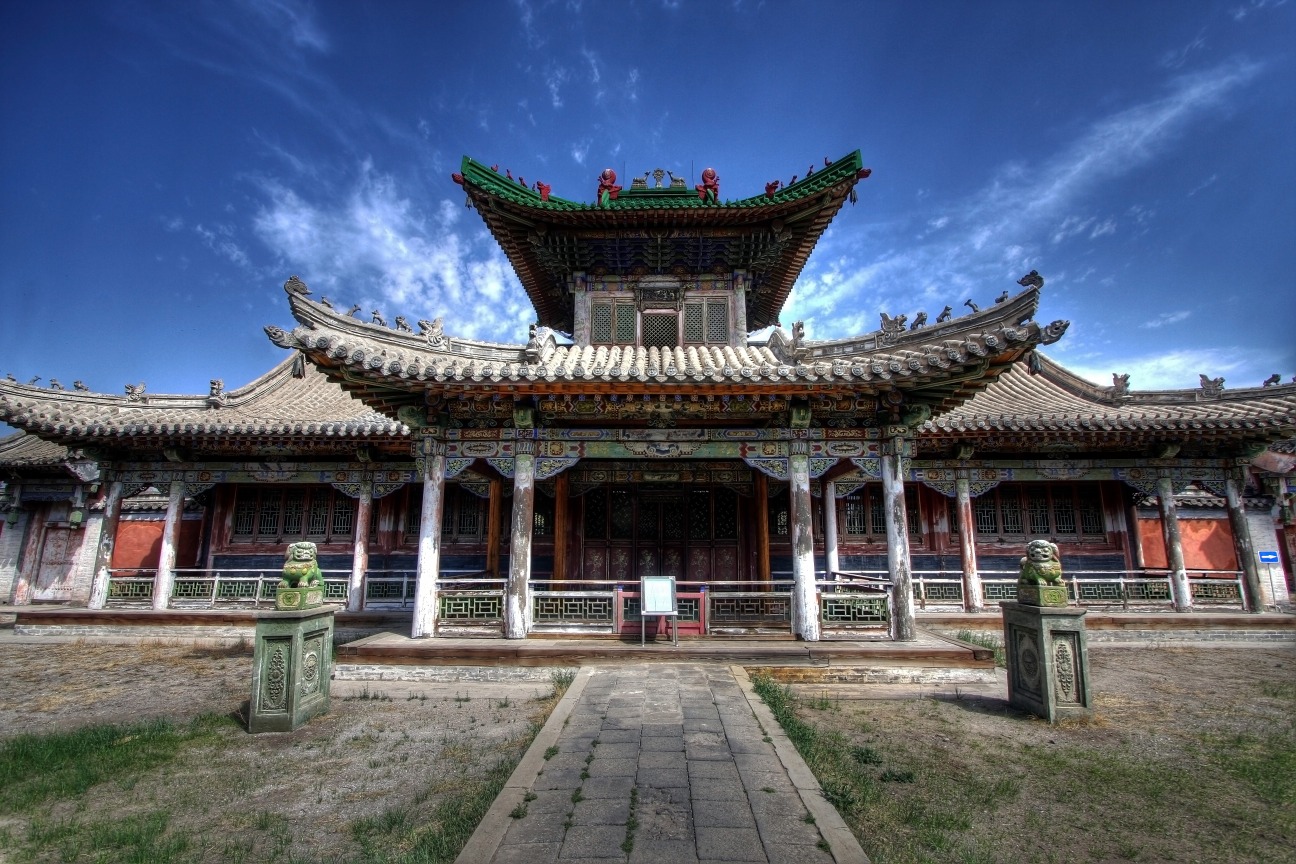
Danzanravjaa Museum
Danzanravjaa Museum
In Sainshand, the Danzanravjaa Museum traces the life of a major 19th-century Buddhist poet and monk, and houses the collections of Mongolia's first museum.
The Danzanravjaa Museum, located in Sainshand in Dornogovi aimag, chronicles the life and work of one of the most striking mystical poets of 19th-century Mongolia. It preserves part of the collections from the "first museum of Mongolia," founded by Danzanravjaa himself in the 1840s at Khamar Monastery.
Why visit the Danzanravjaa Museum
This modest yet singular institution deserves a visit for several reasons:
- A rare collection of original works by a major figure in Mongolian literature, still sung at traditional celebrations today.
- The legacy of a pioneering initiative: public education, theatre, library and museum combined within a single monastery, nearly two centuries before modern cultural policies.
- A story of heritage rescue: part of the collections was hidden during the Stalinist purges of the 1930s and preserved thanks to the loyalty of a lineage of local guardians.
- A coherent stop on the eastern Gobi route, complementing a visit to Khamar Monastery and the energetic site of Shambhala.
Danzanravjaa, the "Terrible Noble Saint of the Gobi"
Danzanravjaa was born in 1803 in the Gobi desert. A man of letters, educator and Buddhist monk, he was celebrated throughout the country and deeply respected by his contemporaries, who nicknamed him the Terrible Noble Saint of the Gobi.
A fierce critic of his era's society, he fought against the rigid class and gender distinctions of his time and championed public education. At the Khamar Monastery, he established a public school that included a theatre, museum and library—an educational approach unprecedented in Mongolia at the time.
Mongolia's first museum
In the 1840s, Danzanravjaa established what is considered Mongolia's first museum. More than 10,000 artifacts were preserved and displayed there in the "exhibition temple" at Khamar Monastery: his personal works and possessions, gifts from the people or from high-ranking religious and political authorities, unusual objects brought back from his travels. Alongside the museum, a public library allowed visitors to listen to public readers aloud reading works—a form of knowledge access adapted to a largely illiterate population.
Considerable literary and artistic output
Throughout his life, Danzanravjaa wrote more than 300 poems, over 100 songs, a philosophical treatise, the ten acts of the operetta Saran Khukhuu, and numerous religious articles written in Mongolian and Tibetan. Several of his texts remain popular today, notably Ulemjiin Chanar, frequently sung at festivals and celebrations. He also painted dozens of religious works, some of which are visible in the museum.
The survival of the collections
During the anti-religious purges of the 1930s, Khamar Monastery was destroyed. A significant portion of the original collections was then hidden by temple guardians and preserved in secret for several decades, before being returned to the State after 1990. This fund now forms the core of Sainshand's exhibitions.
What to see at the museum
The museum displays several original artistic works by Danzanravjaa as well as objects related to his life and teaching:
- Manuscripts and ancient books in Mongolian and Tibetan, including some of his poems and religious treatises.
- Religious paintings by his hand, with Buddhist themes.
- Theatre costumes used for performances of the operetta Saran Khukhuu.
- Religious artifacts: statuettes, ritual objects, ceremonial instruments.
- Personal effects: clothing, furniture, objects from travels to Tibet and other visited regions.
Everything is presented in a relatively simple manner, with labels primarily in Mongolian. Arranging for an English-speaking guide in advance greatly facilitates understanding of the collections.
Practical information
- Location: centre of Sainshand, capital of Dornogovi aimag, in the south-east of the country.
- Visit duration: allow 45 minutes to 1.5 hours depending on your interest in Mongolian literature and Buddhism.
- Admission: modest entrance fee, standard surcharge for photography.
- Opening hours: open during the day Monday to Friday, sometimes reduced on weekends; verify locally before visiting.
- Languages: signage in Mongolian, English-speaking guide available on request.
How to get there
Sainshand is located approximately 460 km south-east of Ulaanbaatar. Two main options:
- By train: the Trans-Mongolian line serves Sainshand daily from the capital. The journey takes one night and is the most widely used access for independent travellers.
- By 4x4 vehicle with driver: essential if you combine the museum visit with Khamar Monastery (40 km to the south) and eastern Gobi sites.
The museum is located a few minutes' walk from Sainshand's centre, easily accessible once you arrive.
To combine in the region
The museum visit makes full sense when integrated into an eastern Gobi circuit or a broader discovery of Mongolian Buddhism:
- The Khamar Monastery, the place where Danzanravjaa founded his school and original museum, an hour's drive south of Sainshand.
- The Gandantegchinlen Monastery in Ulaanbaatar, the main centre of contemporary Mongolian Buddhism, useful at the start or end of your trip.
- The Gunj Temple, another religious complex in eastern Mongolia with a very different character.
Planning your trip
The Danzanravjaa Museum fits naturally into an itinerary including the Gobi and its Buddhist sites. To build a tailor-made journey combining literary heritage, monasteries and vast landscapes, consult our trips to Mongolia.
Interested in this visit?
We can include it in your personalised itinerary.